





The Hidden Cost of House vs. NCAA: Is America’s Olympic Engine at Risk?
Part I in a Three Part Series
Op-Ed: This article is an op-ed. The views expressed are solely those of the authors, Grayson Bloes and Atlas Metin, and do not necessarily reflect the views of Swimming World Magazine or its staff.
By Grayson Bloes and Atlas Metin
Nearly six months into the House v. NCAA settlement taking effect on July 1, the landscape of college sports has already shifted in dramatic and unintended ways. Athletic departments have rewritten budgets, NIL oversight has tightened, roster management has changed, and Olympic sports are increasingly caught in the crossfire. What was billed as a long-overdue correction for revenue-producing athletes has quickly revealed its hidden costs — and nowhere are those costs more visible than in swimming, diving, and water polo.
Few Americans realize this simple truth: the United States dominates the Olympics not because of government investment, but because of college sports.
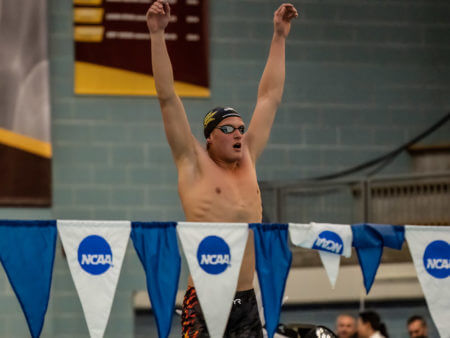
Photo Courtesy: Peter H. Bick
The NCAA has long functioned as America’s de facto Olympic development system. In 2024 alone, NCAA programs produced:
- 92% of U.S. Olympic swimmers
- 100% of U.S. Olympic water polo athletes
- A majority of U.S. track & field, diving, rowing, and volleyball athletes
This system did not emerge by accident. For decades, it relied on a financial structure in which football and basketball revenues subsidized Olympic sports. Facilities, scholarships, coaching, travel, sports medicine, and academic support for non-revenue sports were sustained through this cross-subsidization model.
House v. NCAA fundamentally disrupted that model. The settlement requires universities to distribute up to $22 million annually from football and basketball revenues directly to athletes. While the ruling rightly addresses long-standing inequities in revenue sports, it simultaneously removes the financial lifeline that supported Olympic sports for generations.
Early Warning Signs
The consequences have already begun to surface:
- Cal Poly eliminated its swimming program in March 2025, citing budget constraints tied to the new financial reality — even after alumni offered $7 million to preserve the program.
- Georgia Tech reduced roster sizes by more than half, despite ranking among the nation’s top 50 athletic departments in revenue.
- SEC men’s swimming programs now average just 22 athletes, with further reductions anticipated by 2027.
 As Swimming World CEO Jack Hallahan has noted:
“Roster cuts and program eliminations are reducing opportunities for athletes, which may shrink the base of competitive swimmers and impact the Olympic pipeline.”
Predictions going back to May 2024 voiced in Swimming World called out early warnings on the potential negative impact on NCAA Swimming well ahead of a California Judge approving this historic settlement.
Olympic sports like swimming, diving, and water polo depend on expensive infrastructure, specialized coaching, and national competition schedules. When athletic departments face financial pressure, these “non-revenue” programs are often the first to be trimmed. Their loss extends far beyond individual campuses, weakening the broader system that has produced generations of American Olympians.
The tragedy of House v. NCAA is not its intent, but its unintended consequences. A settlement designed to create fairness has begun to destabilize the very ecosystem that made the United States the world’s most dominant Olympic nation.
Six months into the House settlement, the warning signs are already clear — but the full impact on America’s Olympic development system is only beginning to unfold.
In Part Two of this series, we examine what’s truly at stake: how the unraveling of the NCAA model threatens the foundation of America’s Olympic pipeline.
Does this mean that the cost to sustain a sport (swimming) is born now by the lower levels – H.S., Club, devo teams? Therefore, to maintain a successful Olympic / world championship stream, it becomes an ‘if you can pay, you can play’ environment. Does this also mean that the expertise and advancements in swimming are now stagnant unless they can be picked up by deep-pocketed teams? We already see the detriments of early specialization in sport. Now what? I look forward to part 2 and more.
Unfortunately, we reached the “if you can pay, you can play” point long ago. Swimmers who make it onto the college teams and certainly those who receive scholarships have had to go through the U.S. club system first. Swimming clubs and those in other sports have been out of reach for many families for years due to cost.