





Sandpipers of Nevada Reimagining America’s Path to Olympic Swimming
By Sandpipers of Nevada Staff
The pool deck at Sandpipers of Nevada looks like a lot of other pool decks. Lane lines. Pace clocks. The sharp chemical bite of chlorine in the air. But look closer at who is training her and at what is being built just beyond the fence line, and something becomes clear: this program is not trying to keep pace with the rest of American swimming. It is trying to get ahead of it.
For the better part of a century, the story of elite American swimming has been inseparable from the story of the NCAA. Coaches recruited. Universities paid. Athletes trained four years, sometimes five, inside a system built on institutional loyalty and semester schedules. It worked, often brilliantly. But a growing number of coaches, athletes and administrators are beginning to ask a question that would have seemed almost radical a decade ago: what if it doesn’t anymore?
What if the demands of reaching and staying at the very top of international swimming require something the college system was never designed to provide?
Sandpipers of Nevada has an answer. And they are building it in the desert.
A Quiet Reckoning
The signs have been accumulating for years, visible to anyone paying close enough attention. Elite swimmers turning professional earlier. International programs, including in Australia, Great Britain and the Netherlands, were built entirely around year-round club-based preparation rather than university competition schedules. A growing tension between what a college program can offer an athlete and what that athlete actually needs to compete at the highest level of a global sport.
The college system offers real things: scholarship, community, competition, structure. But it also carries costs that are harder to quantify. Overlapping competition schedules that cut into long-term periodization. Split coaching attention stretched across a full roster. Training blocks interrupted by academic calendars. An institutional identity that can sometimes run at odds with an individual athlete’s development timeline.
Coaches like Coley Stickles at Texas Ford Aquatics and Mohamed Abdelaal at Scarlet Aquatics are seeing the shift play out in real time. Elite athletes are showing up at their doors, not because they washed out of the college system, but because they are choosing something different. They want individualized attention. A plan built around their quadrennial cycle. A coach whose primary job is them.
These are not athletes who couldn’t make it in the college system. These are athletes who looked at what they needed and made a calculated decision about where to find it.
The trend is not yet a flood. But it is unmistakably a tide. And Sandpipers of Nevada, a program with more than three decades of experience developing elite swimmers outside the collegiate pipeline, believes the wave is only going to grow.
Thirty Years in the Desert
Sandpipers of Nevada is not a new program chasing a trend. Under the direction of head coach Ron Aitken, the program has spent three decades doing something the swimming world has long underestimated: developing world-class athletes in a club environment, without the infrastructure advantages of a major university or a national training center and doing it consistently.
The results have spoken for themselves. Athletes who have come through Sandpipers have competed at the Olympic Games, at World Championships and at the highest levels of international competition. Swimmers including Erica Sullivan, Bella Sims, Katie Grimes and Claire Weinstein have captured medals at major international competitions while swimming with Aitken and the Sandpipers.
Some went through the college system. Some didn’t. What they shared was a foundation built inside a program that treated their long-term development as the primary objective, not the secondary one.
Now Aitken is formalizing that approach into something more explicit: a Professional Training Group and National Team Pathway, designed to serve athletes at every stage of the elite pipeline. Olympic hopefuls. Collegiate swimmers stepping away from or redshirting from their programs. International athletes seeking a year-round training base. And junior swimmers, those between 14 and 17 knocking on the door of national team consideration and needing an environment that can meet them where they are and take them where they are trying to go.
The structure of the pathway reflects a simple but important idea: that elite development cannot be a part-time priority. It requires a 12-month plan, aligned with a clearly defined quadrennial cycle, executed with consistency and intentionality every single day. No gaps. No compromise. No competing institutional demands pulling athletes in two directions at once.
Building the Infrastructure
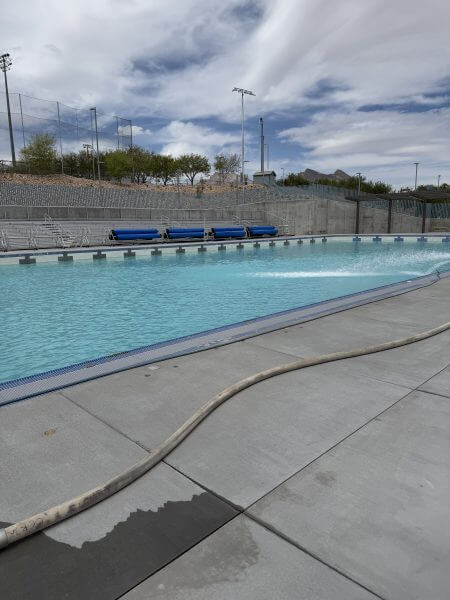
Photo Courtesy: Sandpipers of Nevada
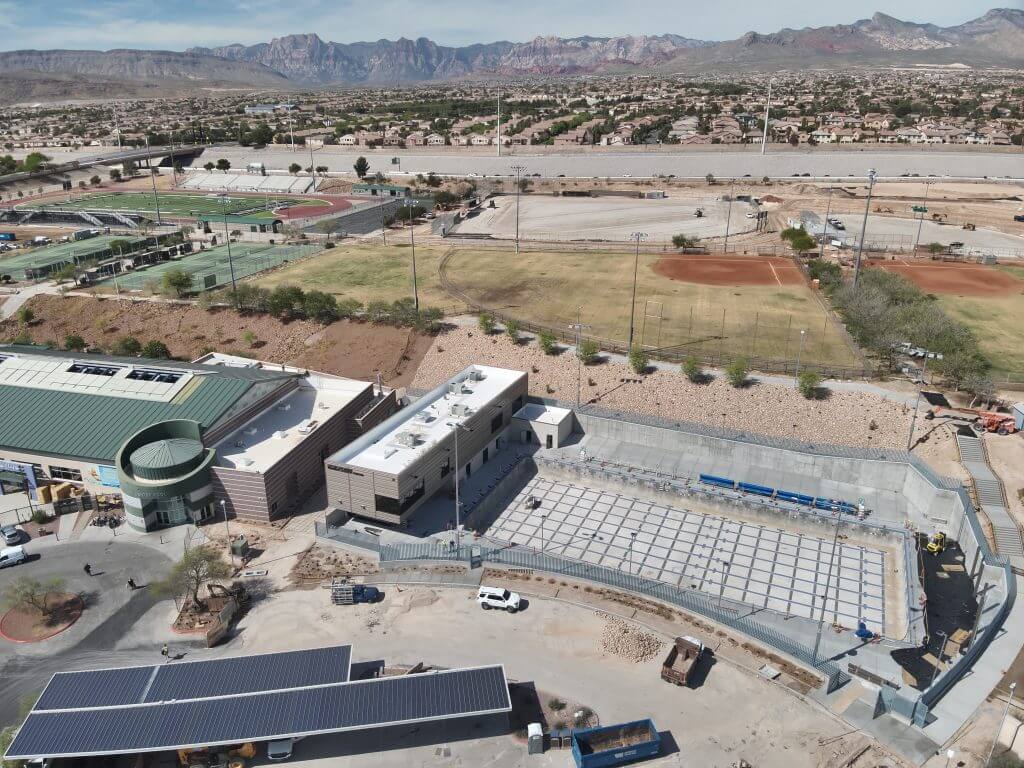
Vision is one thing. Concrete and steel are another. What makes the Sandpipers announcement particularly notable is not just what they are saying. It is what they are building.
Within months, the program will open a new outdoor 50-meter, 8-lane competition pool, added alongside an existing indoor 50-meter facility in partnership with the City of Las Vegas. The combination of indoor and outdoor long-course venues gives the program something genuinely rare in club swimming: the ability to train at competition length, in competition conditions, every month of the year.
Also scheduled to open this fall is a new 4,000-square-foot high-performance training center, which purpose-built to mirror the layout, services and operational philosophy of the United States Olympic Training Center: integrated strength and conditioning, recovery facilities and performance support. This includes everything an elite athlete needs to train fully, recover properly and show up prepared to compete at the highest level.
Together, these facilities represent one of the most significant investments in club-based elite training infrastructure anywhere in the country.
The message being sent is deliberate. Las Vegas, long associated with entertainment and professional sports franchises, is quietly positioning itself as a hub for elite aquatics development, and Sandpipers is the program making that case.
Aitken’s vision for the environment goes beyond physical infrastructure. He is expanding his own role on deck: more direct mentorship of coaches and athletes, broader use of video analysis and performance data and more deliberate in-room learning across all program levels. The goal is an environment where information flows freely, where athletes understand not just what they are doing but why and where the standard is set every single day by the people training alongside them.
The Return

Brennan Gravely — Photo Courtesy: Sandpipers of Nevada
Every program evolution has a moment that crystallizes what it is really about. For Sandpipers, that moment is the return of Brennan Gravley.
Gravley grew up in this program. He trained under Aitken, developed inside the Sandpipers’ system and went on to compete at the University of Florida before representing his country on the international stage, culminating in a gold medal at the Pan American Games. He knows what the program demands and helped build the culture. He knows what it produces. And now he is coming back, not as an athlete seeking more, but as a coach ready to give it.
His hiring is significant for reasons that go beyond his résumé. Gravley represents something rare and valuable in coaching, a person who has actually done what he is now being asked to help others do. He has stood on an international podium. He has felt the weight of competing for a country, not just a team. He has experienced firsthand what separates training that prepares an athlete and training that merely keeps one fit.
That kind of knowledge is not taught in a coaching certification course. It is earned. And for the athletes training at Sandpipers, particularly the younger ones watching what is possible, his presence on deck is a daily reminder that the path they are on is real.
He is not just joining the staff. He is helping to define where the program is going and what it means to get there.
This is the model Aitken is building toward: a complete pathway, where athletes come in as juniors, train alongside professionals, develop under coaches who have competed and or coached at the highest levels.
What This Means for American Swimming
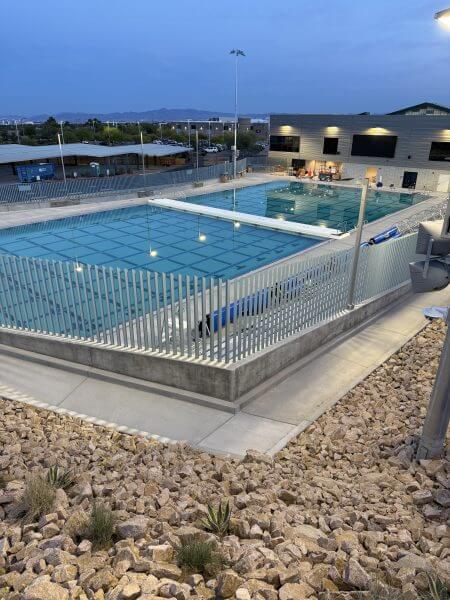
Photo Courtesy: Sandpipers of Nevada
The question hovering over all of this is larger than one program in one city. American swimming has long been the dominant force in international competition. But dominance is never guaranteed and the systems that produced it are not static. The rest of the world has not been standing still.
Countries that have historically trailed the United States in the pool have spent the past two decades making deliberate investments in club-based, year-round, professionally structured training environments. They have built systems where development is the priority, not academic schedules, not conference championships, not institutional branding. The results of those investments are now showing up on international scoreboards.
What Sandpipers is building is, in part, an American response to that reality. It is a bet that the club model can produce results that match or exceed what the college pathway has delivered. The model must be at a high enough level, with the right infrastructure and coaching and built around a genuine long-term philosophy. It is a bet being placed not by an outsider critiquing the system, but by a program that has been doing exactly this work, quietly and consistently, for more than three decades.
There is also something being built here that does not show up in split times or world rankings. Sandpipers is actively working to support athletes in their lives beyond the pool. That includes building relationships within the Las Vegas community to create pathways for career development, education and professional growth. The vision is an environment where athletes do not have to choose between training at an elite level and building a sustainable life. Fast swimming is the goal, but becoming a complete person is the expectation.
A Future Being Built Now

Brennan Gravely — Photo Courtesy: Sandpipers of Nevada
The outdoor pool is still under construction with 4-6 weeks left until its opening. The training center is still taking shape. Gravley is just settling into his new role. In many ways, the thing Sandpipers is announcing is not yet finished. It is time to think about what’s possible.
But that is also what makes this moment worth paying attention to. Watching a program at an inflection point, before the results are in, before the medals validate the philosophy, before the model has been proven out at scale, offers something that retrospective coverage cannot. It offers the chance to understand why decisions are being made, not just what they produced.
Aitken has spent thirty years developing elite swimmers in a city most people associate with anything but athletic excellence. He has done it without the recruitment budgets of major universities, without the name recognition of coastal programs and without the structural advantages that institutional sport provides. He has done it by building something that works — and now he is building something larger.
The athletes who come through Sandpipers in the next Olympic cycle will train in facilities that did not exist six months ago. They will be coached by people who have gold medal experience and are part of sharing that expertise raises athletes to the next level. They will be part of a program that has decided, deliberately and without apology, that the future of elite swimming does not belong exclusively to any one system.
That future, as far as Sandpipers of Nevada is concerned, is being built right here in Las Vegas.