




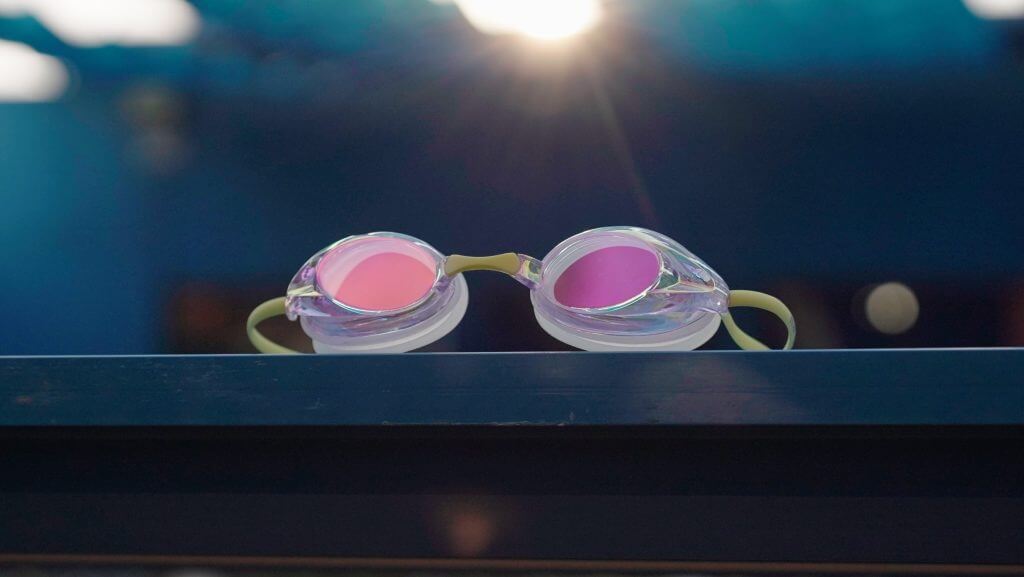

When Vision Disrupts Training
If you start a season with perfectly clear goggles and find them fogging a few weeks later, you’re not alone. Anti-fog treatments perform well at first, but they rarely last under the daily demands swimmers place on them.
It is a frustration shared at every level of the sport.
You begin a long main set with various intervals, equipment changes, drills, and breathing patterns. Halfway through, your goggles cloud over. At the wall, you take them off to get a quick glance at the set.
By the time you figure out the next few intervals, you’ve missed the interval, and your teammates are already off the wall.
You spend the next rep trying to catch up, and when you get back to the wall, you have 15 seconds to change equipment. You spend that time changing equipment rather than reading ahead for the next segment of work.
The next time you’re back, you remove your goggles again to figure out the next few reps, the intervals, and whether you need any equipment.
The Performance Cost of Limited Clarity
Clear vision determines whether you stay on interval, execute the correct drill, or understand what comes next. Yet reading a whiteboard often requires removing goggles entirely or hovering inches away from the printed workout just to make out the writing.
In open water, the consequences increase. Sun glare reflects off the surface, and fog builds inside the lens. A buoy that should serve as a fixed reference point becomes difficult to see, causing athletes to veer off their path.
The Overlooked Equipment Problem
For decades, swimmers have accepted foggy goggles as part of the sport. Goggles perform well for a short period, then gradually decline. Athletes adapt. They wipe the inside of the lens despite manufacturer warnings. They apply anti-fog sprays. They replace pairs mid-season.
This raises a broader question: As technical suits, caps, and training technology have advanced, why has clear, reliable vision in the water remained such an unresolved challenge?
Understanding Anti-Fog Coatings
Most swim goggles use a thin anti-fog coating on the inside of the lens. Instead of allowing condensation to bead into droplets, the coating spreads moisture evenly across the lens in a thin, transparent layer.
When new and undamaged, this coating works well, creating that “new goggle clarity.”
Why Anti-Fog Wears Off
The problem with a coating is that, over time, it degrades due to:
- Repeated exposure to chlorine or saltwater
- Cycles of wetting and drying
- Sunscreen and skin oils
- Touching or wiping the inside of the lens
Looking Beyond Surface Coatings
Claude Deng, founder of Maritonia, heard similar frustrations from his daughter, who seemed to go through a pair of goggles every few months.
Claude had spent years working with precision endoscopes in clinical settings. His daughter’s frustrations raised a question: How could the lenses he worked with in high-moisture environments remain clear, yet his daughter’s swim goggles could not?
Maritonia formed out of a desire to solve a problem that every swimmer has faced. Claude wanted his daughter to enjoy the sport without being limited by her equipment.
A Structural Approach to Clarity
That exploration resulted in Maritonia’s HydroClear goggles.
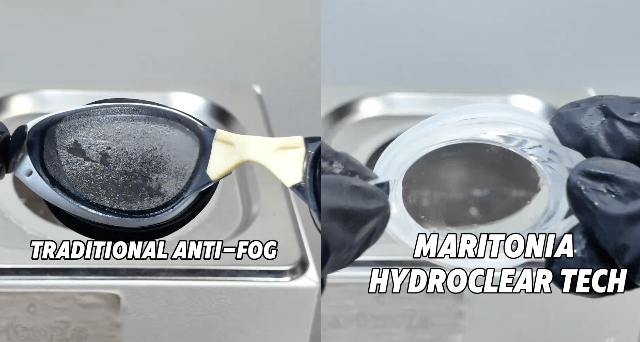
Instead of applying a temporary anti-fog layer, Maritonia takes a structural approach by chemically bonding the antifog materials into the lens.
Because the anti-fog capability is built into the lens itself, the material also creates greater hardness and durability. The surface is more resistant to rubbing and scratching from repeated handling. It also holds up better against chemical exposure from chlorine, saltwater, and sunscreen.
Performance in Practice
In training, swimmers no longer need to repeatedly remove, rinse, or spray their goggles to regain clarity. Less time at the wall adjusting equipment allows for uninterrupted focus throughout the set.
Swimmers report consistent clarity throughout entire practices—something they often don’t experience with traditional lenses.
In open water, swimmers don’t have to roll onto their backs to clear fogged lenses and regain their sightlines. They can stay aligned with the course and keep their focus on the next buoy rather than on their goggles.
Fogging has long been accepted as part of the sport. HydroClear challenges that assumption, treating it as a performance issue to solve rather than a nuisance to manage. Want to represent gear that actually solves this problem? Join the Maritonia affiliate team.