




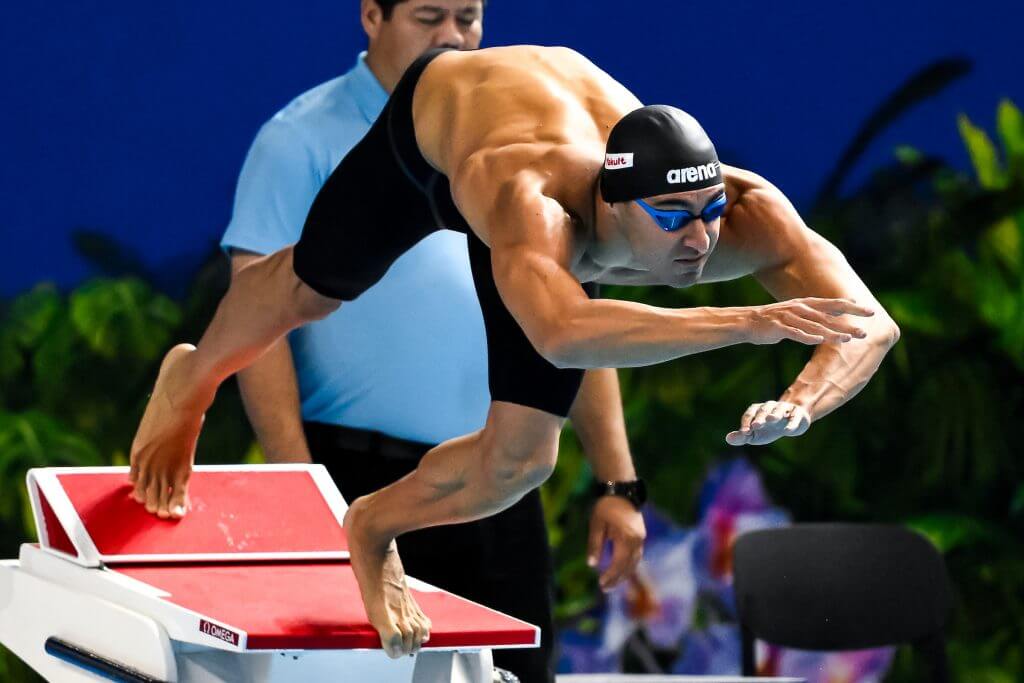















World Record Continues Massive Year of Sprinting for Egor Kornev
When Russian swimmers returned to international competition in 2025 after almost three years in exile, Olympic medalist Kliment Kolesnikov and world-record holder Evgeniia Chikunova were the ones whose presence was most anticipated. Indeed, both came through at the 2025 World Championships, with Kolesnikov claiming the 50 backstroke world title while Chikunova won silver in the 200 breaststroke. Kolesnikov’s fellow backstrokers Miron Lifintsev and Pavel Samusenko also produced world-ranking-rattling performances.
On the meet’s final day, the team competing as Neutral Athletes B won gold in the men’s 400 medley relay. Lifintsev led off before Kirill Prigoda and Andrei Minakov handled the middle legs, returning to their elite status from pre-2022. France had the lead after the third leg, but Egor Kornev produced a 46.40 freestyle split on the way home to deliver a win by more than a second, with a European record to boot.
At that same meet, Kornev placed fifth in the individual 50 and 100 freestyle finals, and he helped the Neutral Athletes win silver in the mixed 400 free relay. That set him up to take the next step in 2026, and indeed, the 22-year-old has now become one of the best sprinters in the world based on his results from three competitions over the past four months. The most recent of those meets made Kornev a world-record holder for the first time.
At the Russian Championships in early June, Kornev exploded to a time of 21.06 in the 50 freestyle, 0.37 quicker than his best time from before the meet and good enough to make him the fifth-fastest man in history, within two tenths of the world record Cam McEvoy set in March. The others to ever go faster included Cesar Cielo, Fred Bousquet and Caeleb Dressel. At the same meet, Kornev achieved his first 46-second flat-start swim in the 100 free, going 46.96.
Kornev followed that up with a six-medal performance at the European Championships, including a gold medal in the 50 butterfly. He clocked 22.36 in the semifinal round, making him the third-fastest man in history behind Andriy Govorov and Dressel and coming within a tenth of the world record. The next night, Kornev edged world champion Maxime Grousset for gold by two hundredths.
At the same meet, he earned silver in the 100 free in the first heat ever where three men swam sub-47. While David Popovici won the race in 46.56, Kornev grabbed silver in 46.74 (with Kristof Milak third in 46.87). The swim moved him to third all-time behind Pan Zhanle and Popovici. Additionally, Kornev tied for silver in the 100 free while securing two relay golds and a silver.
Then came the World Cup meet in Baku that put Kornev into the history books, his 44.84 in the short course 100 free matching the global mark first set by Kyle Chalmers five years ago. That swim rightfully got the lion’s share of attention, but Kornev also fired off three 50-meter blasts to put the world on notice in other events.
He swam a time 20.26 in the 50 free, finishing second behind McEvoy by four hundredths and becoming the fifth-fastest man in history. The next day, Kornev made a rare appearance in a backstroke event and powered his way to a time of 22.23, only 0.12 behind Kolesnikov’s world record and good enough to make him the third-fastest swimmer in history. Forty minutes later came his world record swim in the 100 free. On the final day, Kornev topped the 50 fly in 21.64, making him the third-quickest man ever.
Swimmers typically improve their times throughout the World Cup circuit, putting Kornev in range of multiple additional global standards at the upcoming stops in Tashkent, Uzbekistan, and Astana, Kazakhstan. Expect to see Kornev competing against most of his top rivals at the Short Course World Championships this December in Beijing, and he will be favored or co-favored for multiple individual golds.