




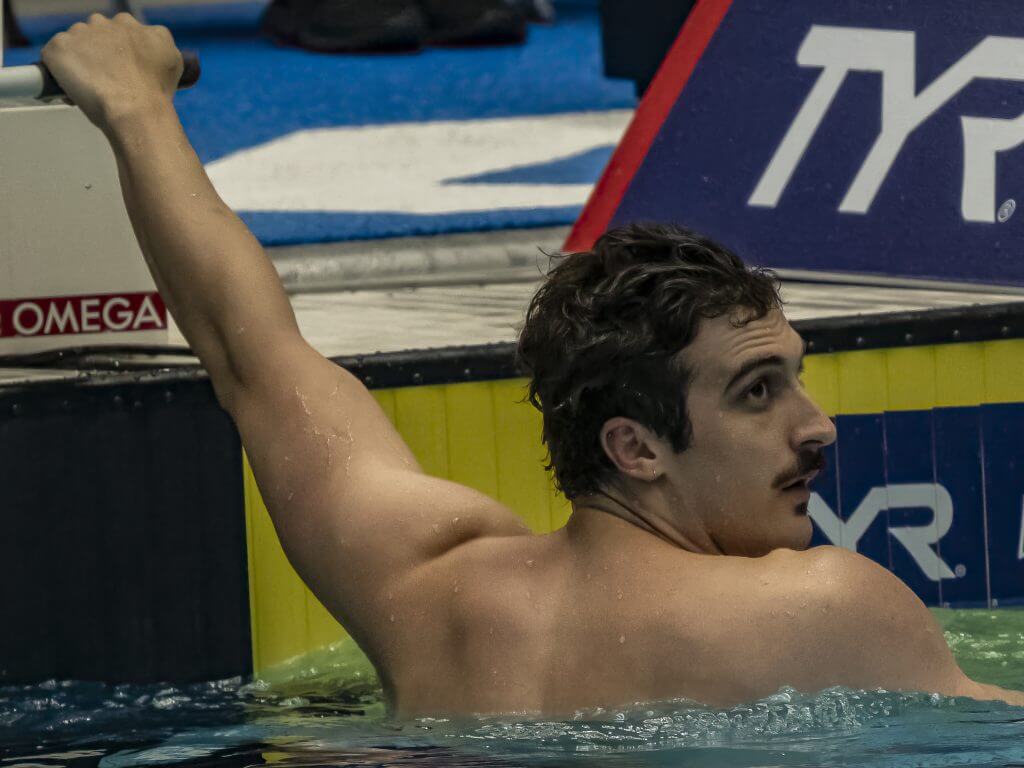















Van Mathias on the Cusp of Joining Elite 57-Second Club in 100 Breaststroke
A rapid ascendance up the standings in the men’s sprint breaststroke events is nearly complete. Van Mathias did not even compete at last year’s U.S. selection meet for the World Championships, but now he holds national records in both the 50 and 100-meter distances. Mathias has lowered the 50 breast record twice this year, with a time of 26.39 in April and then a 26.30 last weekend in Indianapolis. Also in Indy, he nabbed Michael Andrew’s record in the 100 with a time of 58.01.
An incredible performance, quicker than the time required to win gold at last year’s World Championships, a full second quicker than the Olympic-gold-medal-winning time from Paris and quicker than any swimmer has gone in more than two years — but millimeters short of breaking 58 for the first time.
Given his remarkable performances throughout the year, Mathias had surely considered the possibility of joining that group, one Adam Peaty pioneered in 2015 and only Arno Kamminga of the Netherlands and Qin Haiyang of China have joined in the 11 years since.
Peaty first took command of the 100 breaststroke at the 2015 British Championships, when he clocked 57.92 to blast the existing world record belonging to Cameron van der Burgh by more than a half-second. Peaty then lowered the world record on four additional occasions: twice at the Rio Olympics, with a 57.55 in prelims and then 57.13 in the final as he won his first Olympic gold by 1.66 seconds.
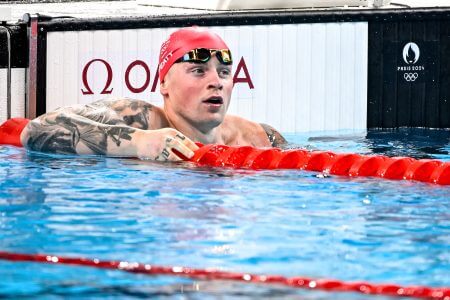
Adam Peaty is a two-time Olympic champion and the world-record holder in the men’s 100 breaststroke — Photo Courtesy: Giorgio Scala / Deepbluemedia / Insidefoto
After Rio, Peaty introduced the concept of “Project 56,” another seemingly unfathomable barrier that he hoped to reach. Indeed he would. He swam 57.10 to break the record at the 2018 European Championships, and a year later at the Gwangju World Championships, Peaty got into the 56s in the semifinal round, clocking 56.88 for a mark that still stands. At the time, his advantage on any other swimmers in history was 1.4 seconds.
Kamminga would come next, establishing himself as a legitimate threat for an Olympic medal in Tokyo when he clocked 57.90 in early 2021. Kamminga would back up that performance at the Games, topping out at 57.80 in prelims before swimming 58.00 in the final to earn a silver medal.
Two years later, Qin emerged on the scene and put together one of the most dominant seasons in one stroke in swimming history. He became the first swimmer of either gender to sweep the 50, 100 and 200-meter events at a World Championships (Kaylee McKeown would match him in women’s backstroke one day later), and in the process, Qin lowered the 200-meter world record while moving to No. 2 all-time in the 50 and 100. In the 100, Qin first got under 58 in May with a time of 57.93, and he swam five more sub-58 performances throughout the year, swimming his best time of 57.69 on two occasions.
Peaty, meanwhile, has been sub-58 on more than 20 occasions, most recently with a 57.94 at the 2024 British Trials.
That is the entire list, with Mathias’ 58.01 making him the fourth-fastest performer in history and the top swimmer globally in 2026 by more than a half-second. He will continue aiming for 57s for the rest of the year, with his debut on the United States “A” team coming in August at the Pan Pacific Championships. Mathias qualified for Pan Pacs based on his 2025 time in the 50 breast, but the format of Pan Pacs allows swimmers to race whatever events they would like, so he is a lock to swim the 100 breast and potentially take on medley relay duties for the United States.
Two more hundredths to a 57, an achievement that swimmers such as Andrew, Paris Olympic champion Nicolo Martinenghi, short course world-record holder Ilya Shymanovich and others have fallen just short of. More importantly, that speed has positioned Mathias to make a run at international hardware.