






ESPN airing NCAA Water Polo Championship 3pm PST
 Stanford, Calif. – Same pool, same rivals, same trophy on the line – but with just enough change on both benches to make the 2025 NCAA Men’s Water Polo Championship feel wide open.
On Sunday afternoon at Stanford’s Avery Aquatic Center, UCLA and USC meet again for the national title. The Bruins are chasing a repeat behind the goalkeeper who emerged on last year’s championship weekend, Nate Tauscher, and a now-seasoned young core. The Trojans arrive with a deeper roster, a defense-first identity and a revamped spine that has already beaten UCLA twice this season.
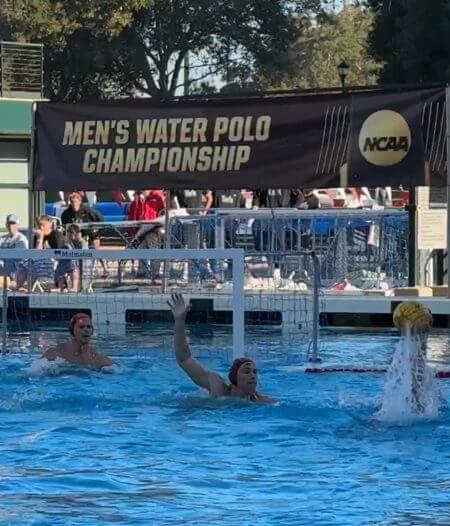
USC Defense too much for Fordham
The question hanging over the final is simple: Has USC changed enough to flip an 11–8 loss into a championship win – or will UCLA’s big-game experience carry the day again?
How We Got Here: Semifinal Wins Set Up a Heavyweight Rematch
USC was first to book its ticket with a dominant 16–7 win over Fordham in Saturday’s semifinal. The Rams arrived with one of the most explosive attacks in the country, but USC’s pressure defense turned the game into a runaway after a 1–1 opening stretch.
The Trojans’ press forced steals, field blocks and rushed shots, and goalkeeper Charles Mills steadied things with nine saves as USC broke the game open in the middle quarters. By the time Fordham finally found a rhythm on offense, the top seed’s lead was insurmountable.
In the late semifinal, UCLA outlasted host Stanford 9–7 in a defensive grinder worthy of the rivalry. The Bruins turned a 6–4 advantage into a 7–6 deficit late in the third quarter before slamming the door: a 3–0 closing run, clutch goals from Frederico Jucá Carsalade and Ryder Dodd, and a statement performance in goal from Nate Tauscher, who came up with a string of fourth-quarter saves to silence a packed Cardinal crowd.
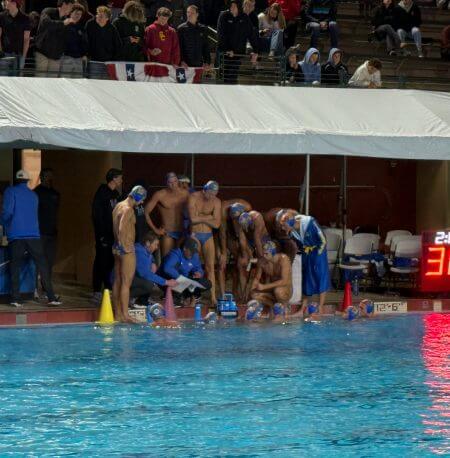
UCLA Coach Adam Wright draws up strategy against Stanford
Those wins deliver the matchup everyone circled when the bracket dropped: a UCLA–USC championship rematch, in the same venue, with both teams slightly retooled and convinced the gap has shifted in their favor.
Last Year at Stanford: UCLA’s Late Surge Sinks USC
In the 2024 NCAA final, UCLA and USC were deadlocked for three quarters before the Bruins took control late to win 11–8 and claim the program’s 13th national title. The game was tied 4–4 at halftime; in the second half, Tournament MVP Ryder Dodd delivered two crucial goals, UCLA’s defense tightened, and the Bruins held USC to just one goal over the final eight minutes.
Equally important was what happened in the cage. UCLA turned to redshirt freshman goalkeeper Nate Tauscher at the start of the NCAA tournament, and he delivered a breakout performance, posting 10 saves in the championship game and stabilizing the Bruins when USC pushed in the fourth quarter.
That title run was a turning point for UCLA’s younger core. Surrounded by veteran shooters like Jack Larsen and seasoned leaders in the field, Dodd and Tauscher learned how to close out big games on the sport’s biggest stage – experience that now defines UCLA’s identity heading into 2025’s final.
What’s Different About UCLA in 2025?
Same Last Line of Defense, Bigger Roles Up Front
If there is one constant in Westwood, it’s the last line of defense. The same goalkeeper who helped secure last year’s title, Nate Tauscher, now returns a year older and even more central to how UCLA plays.
After stepping in as a redshirt freshman starter for the 2024 NCAA tournament and anchoring the 11–8 win over USC with double-digit saves, Tauscher has grown into a calm, vocal presence. He reads drives earlier, manages the defense’s drop and press calls, and gives the Bruins immense confidence in tight fourth quarters – as he showed again with a 16-save effort in the semifinal win over Stanford.

Around him, head coach Adam Wright has reshaped the attack around a younger but battle-tested core:
- Ryder Dodd – Last year’s freshman star is now a fully established headliner. He can create his own shot from the perimeter, win one-on-ones off the dribble and change momentum with a single possession.
- Frederico Jucá Carsalade – A creative attacker with an expanded role, Carsalade blends scoring and vision. His two goals against Stanford and ability to thread entry passes make him UCLA’s most versatile playmaker.
- Nate Tauscher – The keeper who broke out during last year’s NCAA run now firmly owns the cage. His semifinal performance against Stanford underlined that UCLA can still ride elite goaltending – but now from a goalie who has already won a national championship in this pool.
Supporting pieces like Ben Larsen, Eli Liechty and a wave of underclassmen have stepped into larger roles, making this UCLA team slightly younger, more by-committee on offense, and every bit as suffocating when it locks in on defense.
What’s Different About USC’s “New Look”?
Defense First, Depth Everywhere
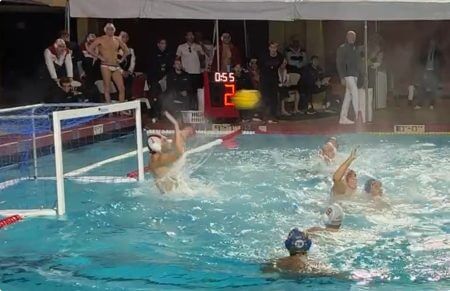
Stanford Goalie Wes Temkin blocks UCLA’s Chase Dodd’s shot
If last year’s USC often felt like a high-powered attack trying to outscore everyone, this year’s Trojans look more like a boa constrictor. Their calling card is a physical, connected front-court defense that feeds a deep, unselfish offense.
Against Fordham in the semifinal, that identity was on full display: USC kept one of the country’s highest-scoring offenses under 10 goals, turned live-ball turnovers into counterattacks and spread 16 goals across a long list of contributors. When the Trojans defend at that level, they don’t need any single player to carry the scoreboard.
The New Spine: Transfers, Internationals and a Captain in the No. 2 Cap
USC’s “new look” revolves around a spine that blends returners, transfers and rising international talent:
- Robert López Duart – A proven closer, López Duart has evolved from pure finisher into a player who can dictate tempo and score in every phase, from front-court to counterattack.
- Mihailo Vukazić – A high-impact grad transfer, Vukazić has added range and vision to USC’s left side, stretching defenses and opening lanes for USC’s centers and drivers.
- Stefan Branković (#2 cap) – The Serbian utility and captain is the symbol of USC’s shift. Equally comfortable as a passer, scorer or post defender, he piles up assists, draws exclusions and turns broken plays into high-percentage chances.
- Two elite goalkeepers – With both Charles Mills and Bernardo Herzer capable of handling big-game minutes, USC effectively has two “captains in red.” That depth in goal gives head coach Marko Pintaric the freedom to mix coverages and dictate how aggressively the Trojans press or drop.
USC did lose some size and experience at two meters from last season, but has reloaded with a deeper center rotation and a more cohesive defensive unit. The result is a team that still scores in bunches – but now expects to win games by choking off lanes, winning the steal battle and letting its depth wear opponents down.
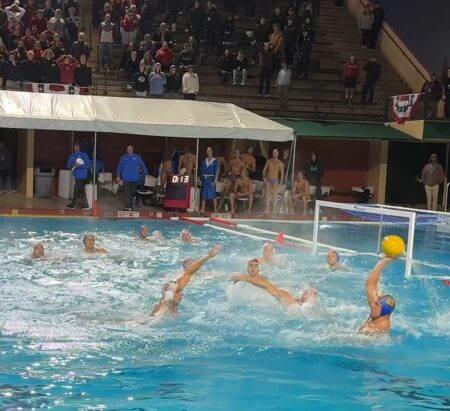
UCLA closes out Stanford
How USC Beat UCLA Earlier This Season
USC 13, UCLA 12 – Stealing One in Westwood
The first sign that USC’s changes were real came in Westwood. UCLA entered on a long winning streak dating back to its 2024 title run; USC walked out with a 13–12 road upset.
The Bruins jumped ahead 3–1 before USC’s new spine took over. Vukazić poured in a first-half hat trick and distributed the ball, López Duart and Efe Naipoğlu added multi-goal outings, and USC led 7–6 at halftime.
Late in the fourth, the teams were tied 12–12 when senior center Jack Martin ripped the eventual winner off a feed from Vukazić. A final defensive stand sealed it – exactly the kind of closing sequence that had slipped away from USC in last year’s NCAA title game.
USC 14, UCLA 11 – MPSF Title at Avery
The second statement came back at Stanford, in the MPSF Championship game. USC blitzed UCLA early, building a 10–5 halftime lead and never letting the Bruins closer than three in a 14–11 win that delivered a fourth straight MPSF tournament crown.
The blueprint: efficient shooting, balanced scoring and front-court defense that forced UCLA into more low-percentage perimeter attempts while limiting clean entries to the post. The Trojans didn’t just win – they dictated every aspect of how the game was played.
The One That Got Away: UCLA 14, USC 13 at Uytengsu
Of course, this rivalry doesn’t move in a straight line. In the regular-season finale at Uytengsu Aquatics Center, UCLA answered with a dramatic 14–13 win, rallying late to reclaim the No. 1 ranking heading into the postseason.
USC’s offense was still dangerous, especially on the power play, but lapses at the defensive end and a late flurry from UCLA’s shooters swung momentum back toward the Bruins. That game is a reminder that even with USC’s improvements, the margins between these two are razor-thin.
Those three meetings – the road win in Westwood, the MPSF burst at Avery and UCLA’s season-ending answer in Los Angeles – form the backdrop for Sunday’s rubber match.
Keys to Sunday’s Final: New Look vs. Repeat Bid
For USC
- Keep it a defensive game. When USC holds elite offenses in the low teens and wins the steal/field-block battle, its depth and counterattack usually finish the job.
- Let the spine dictate. If López Duart, Vukazić and Branković control touches and tempo, they can turn possessions into either high-percentage shots or man-up chances.
- Win the goalie battle. If Mills and/or Herzer can outplay Tauscher over four quarters, USC’s “new look” may finally cash out in a national title.
For UCLA
- Lean on big-game equity. Dodd, Carsalade, Tauscher and Wright have already won a championship in this pool. Knowing how to manage timeouts, matchups and momentum in the fourth quarter is a real advantage.
- Protect the ball and the paint. Limiting turnovers and handling USC’s physical front-court defense – especially at two meters – will go a long way toward keeping the Trojans out of transition.
- Tauscher’s moment, again. If Tauscher gets anywhere close to his semifinal level, UCLA’s younger version of its title team may look just as hard to break as it did in 2024.
How to Watch & What’s at Stake
The 2025 NCAA Men’s Water Polo Championship game between USC and UCLA is scheduled for Sunday, Dec. 7 at 3:00 p.m. PT (6:00 p.m. ET) at Avery Aquatic Center. The game will air live on ESPNU and stream on the ESPN App and NCAA.com.
For UCLA, it’s a chance at a 14th national title and a rare back-to-back over its crosstown rival. For USC, it’s an opportunity to prove that its new defensive identity, deeper roster and evolved core have closed the gap that showed up late in last year’s final.
Same rivalry, same setting, same stakes – but with a very real possibility that the ending will be different.
Photo Gallery
KAP7 Official Ball NCAA Championships

2025 NCAA Water Polo Final Rankings

Top Ranked USC has sites set on Championships
References
- NCAA.com – 2025 NC Men’s Water Polo Championship: bracket, schedule and scores.
- Swimming World – 2024 NCAA Water Polo Championships: UCLA Hoists Trophy Behind Second-Half Surge (UCLA 11–8 over USC, with Nate Tauscher’s 10 saves).
- USC Athletics – 2025 men’s water polo statistics, MPSF Championship recap and Fordham semifinal recap.
- UCLA Athletics – 2025 men’s water polo season releases and 9–7 NCAA semifinal win over Stanford.
- Season recaps, box scores and media coverage of 2025 USC–UCLA meetings in Westwood, at the MPSF Championship (Stanford) and at Uytengsu Aquatics Center.
Hashtags:
#UCLA
#UCLAWaterPolo
#UCLAMensWaterPolo
#GoBruins#USC
#USCWaterPolo
#USCMensWaterPolo
#FightOn#NCAAWaterPolo
#MensWaterPolo
#CollegeWaterPolo
#NCAAChampionship
#NCAAWP
#ChampionshipWeekend

Stanford Fans wearing vintage Water Polo Caps