




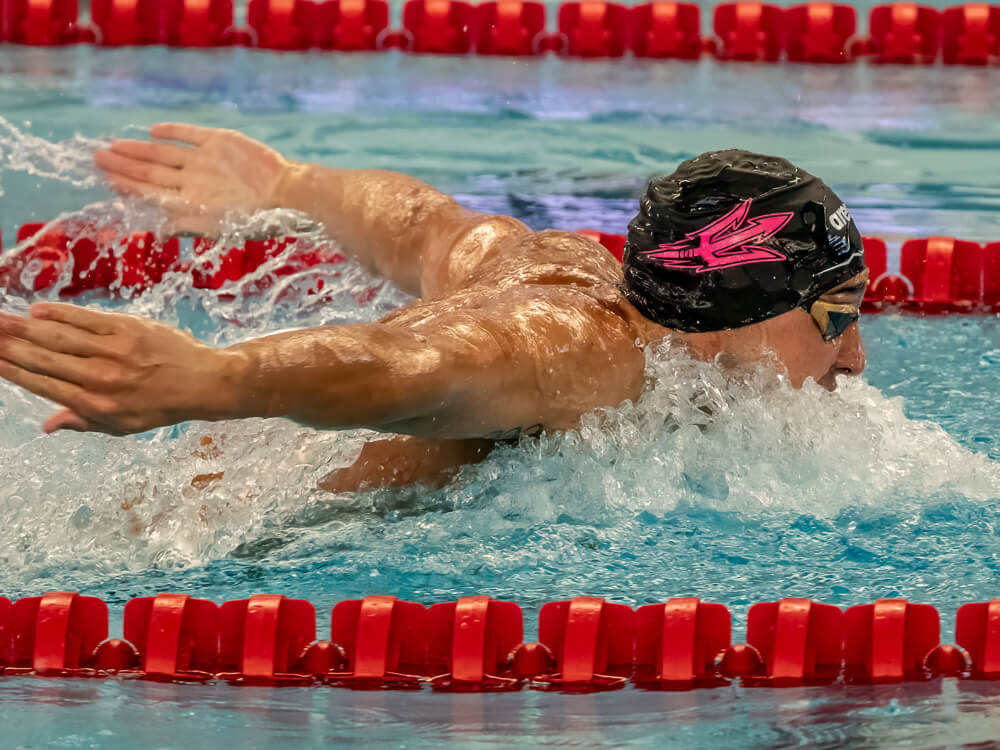















Plan vs. Strategy: The Ways to Approach the 200 Butterfly
Ah, the butterfly. It is routinely acknowledged as a “power” stroke, and the 200 distance is where the rubber meets the road. Butterfly may be the event where there is the least amount of crossover by distance. What I mean by this, is that you can expect most athletes who swim the 100 breaststroke to swim the 200 breaststroke. Same for the backstrokes. There will always be exceptions with freestyle events or IMs making their way into the equation. But butterfly will typically see the fewest amount of swimmers doing both the 100 and 200 distances.
The reason for this is quite simple. Butterfly, being a power stroke, lends itself to being a favorite shorter event. The quick, yet strong, underwaters along with how demanding the stroke can be on the shoulders when at speed, makes the fly a desired sprint event. The 200 fly, on the other hand, might be a different stroke altogether.
Caterpillar to 200 Butterfly
The 200 fly requires precision, stamina and patience. Attempting to replicate the quick kick and whipping arms of a sprint fly event is a guarantee for burn out. Far too often, you will see a lot of tired fly at the end of races following a fast start. The 200 fly demands a more balanced kick rate. Less kicks to conserve energy, but still keeping enough motion to stay on top of the water. Walls, typically a massive element of shorter butterfly, can operate more as rest stops than launching pads. With the 100 fly, a race is won on the walls. With the 200 fly, a race can only be lost by the walls.
This makes the 200 fly a unique event to train. Anything related to brokens need to be communicated as being 200 style brokens. Ripping four fast 50s of butterfly is not the cleanest way to prepare for a 200 fly. This is why patience in the event is so crucial. Understanding the gas tank that you have is imperative in both training and racing in the 200 fly. It’s not butterfly. It’s the 200 fly.
Can We Get There?
From what I have seen, there can be swimmers confident enough in their stamina to make the 200 a constant barrage of pace. The legs are crucial, but it is feasible that a 200 fly can be completed at a consistent speed. Distance swimmers with odd event combinations are cases in point. Since an event like the mile requires slow but constant leg motion, the 200 fly can lend to the same thing. All power and strength to those who try. That kind of leg balance takes time and craft. A smarter way is to train it without fins, as the depth of kick with fins would not be an ideal training plan for a power 200 fly.
And that’s it for the 200 fly. Halfway down with the 200s with two more to go. As the summer drags on, so does any 200 with tired legs.