




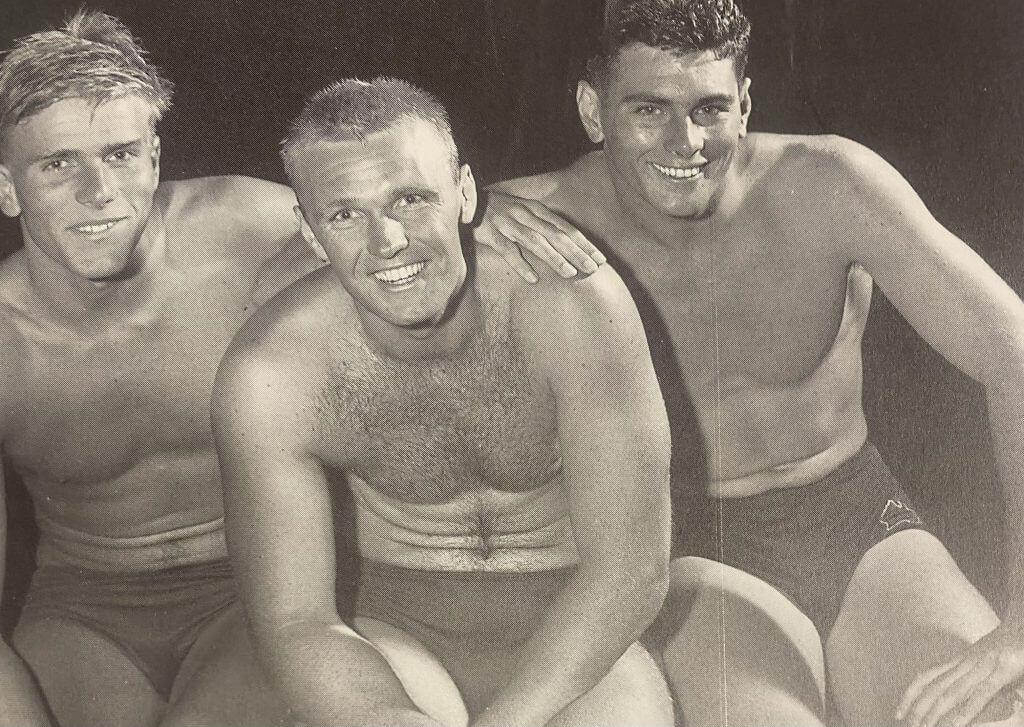















Passages: Australian Olympic Legend Jon Henricks Dies at 91; Once Fastest Man in World
Australian Olympic swimming legend Jon Henricks – once the fastest swimmer in the world – has passed away peacefully today in Santa Barbara, California, at the age of 91. Henricks won Australia’s first Olympic gold medal in the pool at the 1956 Melbourne Olympic Games in the 100-meter freestyle and sadly his passing comes on the 70th anniversary celebrations of those “Golden Games” tomorrow.
The Sydney-born Henricks led Australia to a perfect start to the Games, a spectacular sweep in the blue ribbon freestyle sprint with swim team captain John Devitt winning silver and Gary Chapman the bronze.
Henricks was discovered by coach Harry Gallagher (the “wiley old fox” as he was known) at a combined schools carnival at North Sydney Pool in 1951, when the teenager was attending Fort Street Boys High. Gallagher noticed something in Henricks despite him finishing only fifth in the 440 freestyle.
Twelve months later, Henricks was crowned the NSW champion over 1650 yards, going on to win the Australian championship over 880 yards, silver in the 1650 and bronze over 440 yards.
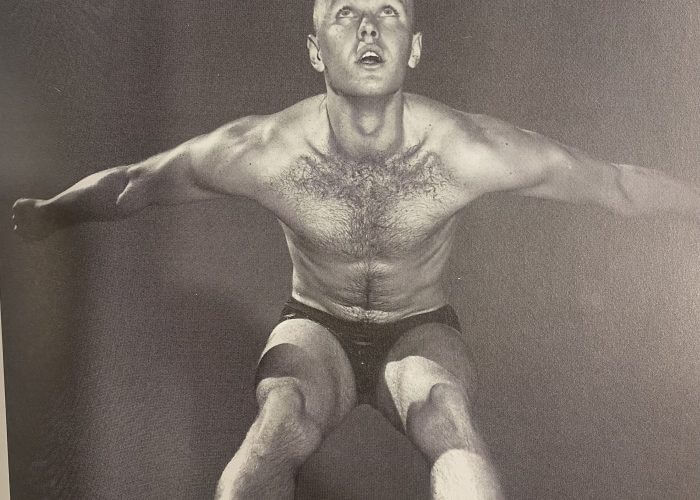
GOLDEN BOY: Jon Henricks won Olympic gold in 1956 in the 100m freestyle in an Aussie sweep. Photo Ern McQuillan (Swimming NSW – Lanes of Gold)
By this time, the 17-year-old Henricks had also been introduced to Professor Frank Cotton – the original sports science guru – working alongside Gallagher, and with Dawn Fraser also in Gallagher’s clutches. They set about transforming the sport, including taper training and shaving. Cotton was the professor of physiology at Sydney University who would conduct experiments on responses to athletic stress of the heart, the lungs and other organs.
It didn’t take long before Cotton’s work with Gallagher proved that young Henricks was better suited to sprint swimming and he would go on to win four straight Australian 100 freestyle titles. Henricks was an automatic choice for the 1954 Vancouver Empire Games, where he brilliantly won gold in the 110 yards. The question was, could he maintain his form for the much-anticipated Olympic Games of ’56 and he sure did.
Despite the conjecture and the emergence of 19-year-old Sydney boy Devitt and Chapman, it was a now 21-year-old Henricks – unbeaten over the distance – who started favourite, winning his heat and semifinal and who would go on to out-touch a fast-finishing Devitt in an Olympic record time of 55.4 – becoming the first ever Australian to win the coveted title. Devitt was second in 55.8 after he was last off the blocks, chasing Henricks down the second lap, and who in the end thought Devitt had won.
“For years I had cruised away from everyone, and no one had come close to me,” said Henricks of his gold medal swim. “I had not been expecting to see John (Devitt) finish so strongly and I was not aware of where he was as he was on my blind side. When I looked over and saw his hand come over I thought he had beaten me.”
In a spectacular home Games, it also launched Fraser’s career with the girl from Balmain. She won the first of her three history-making gold medals in the women’s 100m freestyle, also in an Australian sweep ahead of Lorraine Crapp and Faith Leech.
The firm of Henricks and Fraser, under the astute coaching of Gallagher and the scientific input of Cotton had unlocked a golden era in Australian swimming. Henricks, Devitt, the great Murray Rose (who double gold over 400 and 1500 freestyle) and Kevin O’Halloran went on to win gold in a world time in the 4×200 freestyle relay.
Fraser, Crapp, Leech and teenage whiz kid Sandra Morgan, who was just 14 years and six months, won gold in the women’s 4×100 freestyle relay.
The Melbourne 1956 Games were historic for Australian swimming with the team winning every individual freestyle event for men and women (Crapp winning gold in the 400m freestyle), as well as the relays and the men’s 100m backstroke to David Theile.

Harry Gallagher with Dawn Fraser and Jon Henricks Photo Courtesy Tobruk Baths Hall Of Fame
A prolonged ear infection had ruled Henricks out of the 1952 Helsinki Olympic Games while Illness struck again at the 1960 Rome Olympics, which prevented him from progressing beyond the semifinals of the 100m freestyle. The event was fittingly won by teammate Devitt. He was also forced to withdraw from the relay.
AOC President, Ian Chesterman AM, described Henricks as one of Australia’s greatest Olympic champions.
“Jon Henricks was a giant of the Melbourne 1956 Games and part of a remarkable generation of Australian Olympians alongside Murray Rose, John Devitt, longtime friend Dawn Fraser and many others,” Mr Chesterman said.
“In front of a home crowd he won Australia’s first swimming gold medal then anchored the 4x200m relay team to a world record. That week helped establish Australia’s reputation as a swimming nation, and it still inspires our athletes today.
“While he made his life in the United States, he remained a proud Australian Olympian. On behalf of the Australian Olympic family, I extend our deepest condolences to Jon’s family, friends and the Australian swimming community.”
Swimming Australia CEO Rob Woodhouse said Henricks was revered for his achievements during the golden era of Australian swimming.
“Jon will be remembered as one of our greatest ever champions,” Mr Woodhouse said.
“We are saddened to hear of his passing, especially on the eve of the 1956 Melbourne Olympians celebration.”
Jon is survived by his wife Bonnie Henricks, children Deborah Stran, Michelle Keating, Gretchen Lyssogor and William Henricks, his beloved grandchildren and his sisters Anne Melrose and Jenny Herbertson and their families.

Caricature Courtesy: Tony Rafty Collection.