




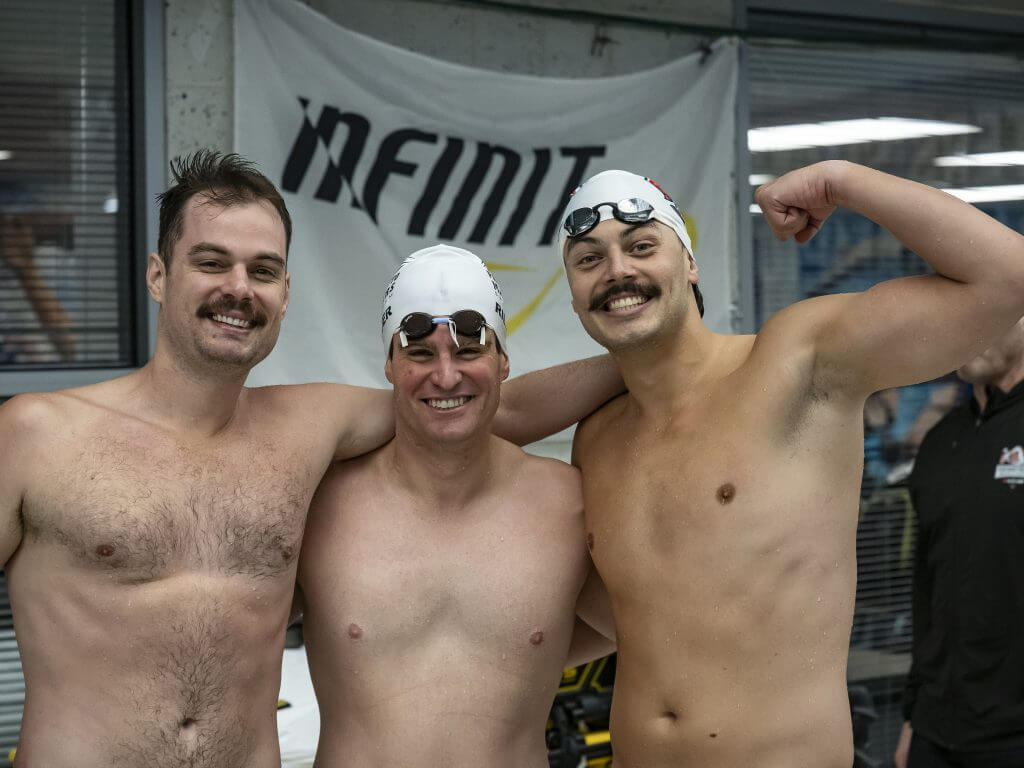















Masters Nationals: A Personal Narrative From Swimming’s Biggest Reunion
Around 2000 swimmers made the trip to Greensboro, N.C., this spring to compete in the U.S. Masters Swimming’s annual Spring Nationals. The group came from all over the country and all sorts of backgrounds in swimming from Olympians and veteran Masters swimmers with national records on one end of the spectrum to locals in their first-ever competition. Somewhere in between those extremes was me, racing at the meet for the fifth time and my first in the 30-34 age group.
Over the previous months, I had wavered if I wanted to attend Nationals this year. I felt hesitant to take multiple days off work and invest money in meet fees and a multi-night hotel stay, but Greensboro is just a four-hour drive from my home in Charleston, S.C., and numerous friends from around the southeast had signed up. Of course, the competitive juices kicked in: I wanted to prove myself against good competition, see how I stacked up.
As a longtime writer for Swimming World, my brain holds a large catalog of swimming information, but the sport matters on a personal level, too. I swim nearly every day, jumping into the water most weekdays between 5:30 and 6 a.m. I represent Palmetto Masters but typically train by myself at a pool close to home. Swimming is my anchor, the best way to set myself up for a productive day.
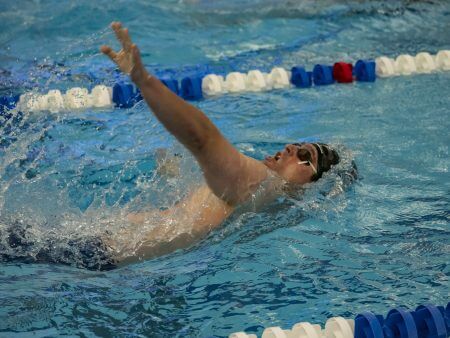
Racing backstroke at Masters Nationals — Photo Courtesy: Peter H. Bick
I care about competition against myself more than anyone else. I swam club in college and continued to train and compete in the years after, hitting best times in most of my main events in my late 20s. After a few seasons of relatively disappointing times, I have rebounded in the past two years in large part thanks to a renewed focus on strength training. In the two years after aging up, I broke South Carolina short course yards state records in the 500 freestyle, 200 backstroke, 200 butterfly and 400 IM. I have actually lowered all those records at least twice.
Breaking records in Masters swimming sometimes comes down to opportunity. As a mediocre sprinter and lousy breaststroker, that left just six potential state-record opportunities, and I handled the first four fairly quickly. All that was left was the distance races, the 1000 and 1650 free. I knew I could reach those times, but I had avoided those events with near-religious fervor for six years.
If I was making the trip to Nationals, though, I had to race the mile. Maybe I would get lucky and face a weak field to give myself a chance to contend for a victory. Unfortunately for those hopes, the psych sheets showed I had little hope of coming out on top. My age group turned out to be the most competitive of the entire meet. Even though I had the ninth-best seed time of any male swimmer, I was seeded sixth for 30-34 swimmers. Among those ahead of me was Anton Ipsen, the NCAA champion in the event in 2018 and a 2016 Olympian for Denmark.
Regardless, I would try to break both state records within one race. I recruited a friend to count my laps, and we made a plan for pacing the race. He would place the counter in the middle of the lane if I was on pace, off to the side if I was swimming too slow. We had a special signal for lap No. 39 in case I needed to speed up or even touch the wall to make sure I secured the time I was chasing in the 1000.
I swam in lane one, and while Ipsen and the other top seeds sped away in the early stages of the race, I was able to get ahead of the swimmers in lanes two and three and hold 50-yards splits under 31 seconds. The first portion of the race felt easy; the middle, not so much, and all I could think about was how the 500 free was definitely not a distance event, not compared to this.
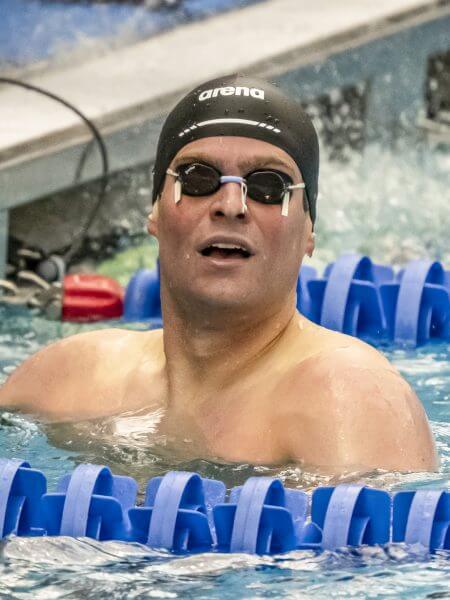
Photo Courtesy: Peter H. Bick
I snuck a few peaks at the scoreboard to check my times, and I knew I was hitting my target pace. Still, I accelerated as I approached the 1000-yard split and made an especially quick turn. My split was 10:11.62, under the previous state record by more than eight seconds. Minutes later, I touched the wall in 16:48.98, crushing my target time by almost 50 seconds and earning a fourth-place finish in my age group.
Over the next two days, I swam four more individual events. Friday, I finished seventh in my age group in the 200 back in 1:58.04, a few tenths behind my state record in the age group from six months earlier, but then I had my fastest 200 IM time in seven years at 2:03.50. I got 11th in that event with a time that would have scored in every other age group in the meet. On my last day of racing, Saturday, I got third in the 200 fly (2:00.61) and 12th in the 100 back (56.10). The 200 fly lowered my state record, and in both events, I swam faster than I had in four years.
Along the way, I was able to connect or reconnect with swimmers from across the country. I saw plenty of Ipsen that week since he happened to choose the exact same events as I did (along with the 400 IM). Naturally, he beat me in everything, although he was disqualified in the 200 fly. It was not the first time we had encountered each other at that pool: 10 years earlier, I was covering the ACC Championships when Anton won the 500 and 1650 free during his sophomore year at NC State.
Now, Anton represents the New York Athletic Club, and one of his teammates there is Ally Howe, an NCAA champion at Stanford and former American-record holder in the 100 back. At this meet, she won all six of her individual events, the three backstrokes plus the 100 and 200 IM and 100 fly. I covered Ally throughout her NCAA career, including at her first national meet in the same Greensboro pool in 2015 and when she broke Natalie Coughlin’s 15-year-old national record in the 100 back at the 2017 Pac-12 Championships.
It was fun catching up with Anton, Ally and U.S. national team veterans Michael Klueh, Reece Whitley and Eugene Godsoe. Two other former elite performers were actually part of my team assembled for this meet, the South Carolina Current, which included swimmers from across the state. Jenny Thompson, the 12-time Olympic medalist known for so many clutch relay swims, joined the Charleston contingent and won all five of her individual events plus a relay to become one of the team’s highest scorers. Cassidy Bayer, who finished third at Olympic Trials in 2016, was competing at her first big meet since retiring from the sport and moving to Columbia.
I stopped and talked with dozens of swimmers before, during and after my warm-up and cool-down, people I had met through all aspects of swimming. That included swimmers I have written about, current Masters teammates and former ones who have since moved away, swimmers who I helped coach years ago, friends who I have met through regional competitions and even some with a degree of separation. Caps featuring logos from certain schools prompted me to stop strangers and ask if they knew a friend who used to swim or coach there.
Masters Nationals is about competition, yes, but it is also the sport’s biggest reunion, a rare chance for swimmers to reunite with old friends and acquaintances and make new connections through our shared swimming experience. When I departed the meet a day early, a feeling of FOMO (fear of missing out) set in, and I immediately began considering if and how I could attend next year’s meet in Irvine, Calif. The swimming lured all of us to Greensboro for an experience few will soon forget.