



















Guest Editorial: The Author’s System of Sprint Swimming Biomechanics (Part II)
Swimming World recently ran Part I of Serhii Lysobei’s extensive article, “The Author’s System of Sprint Swimming Biomechanics.” Now, we run Part II, which examines sprint swimming from a technical perspective.
Part II: The Author’s Technical Elements of the System
2.1. Body Position in the Water
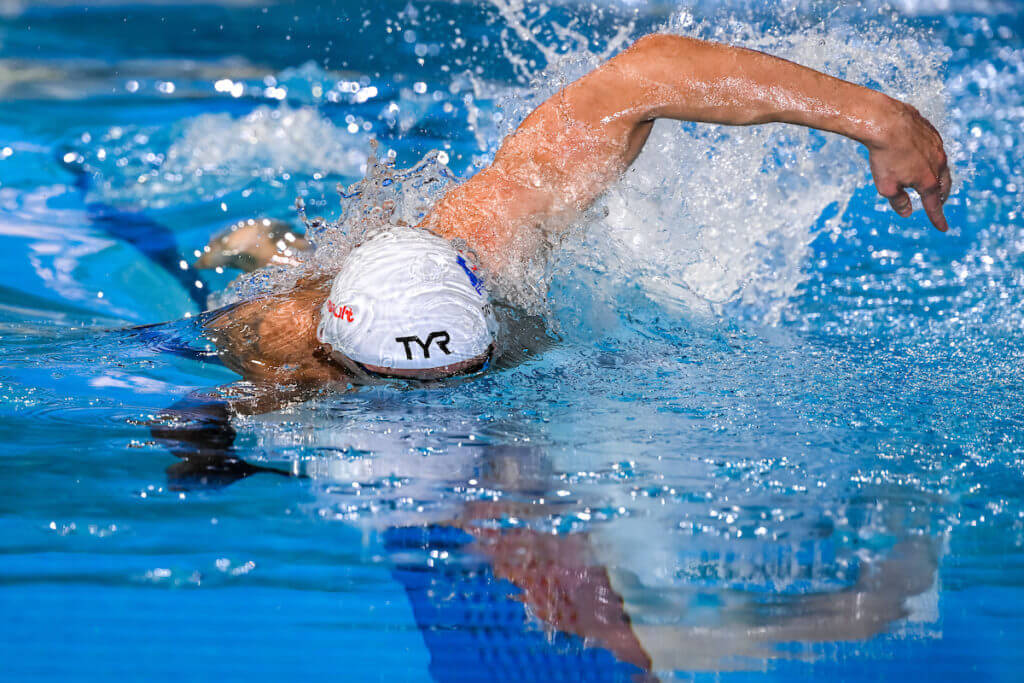
Body position in the water is the foundation of my author’s system of sprint swimming biomechanics. This element has the greatest influence on an athlete’s speed, as it determines the degree of hydrodynamic resistance and the effectiveness of force transfer during each stroke.
Through many years of athletic and coaching practice, I have concluded that most athletes and coaches correctly understand the need for a horizontal body position, but do not always understand the mechanism for achieving it. That is why, within my system, I have formulated a series of original principles that allow an athlete not only to assume the correct position but also to maintain it regardless of swimming speed.
The Principle of True Horizontal
One of the key concepts of my system is the principle of true horizontal.
By this principle, I mean a position of the athlete in the water in which the head, torso, hips, and legs form a single hydrodynamic line with minimal frontal resistance. At the same time, the athlete should not try to artificially hold the body in place using muscular force or consciously “rise” above the water.
A correct horizontal position is a natural result of effective biomechanics, sufficient movement speed, and correct interaction of the body with the aquatic environment.
The Principle of the Internal Level Sensor
When training athletes, I use my own model, which I call the “internal level sensor.”
I ask the athlete to imagine that inside their body, there is a kind of level sensor that continuously monitors the position of the torso. The athlete must learn to sense any deviation from a horizontal position independently, without constant prompting from the coach.
The goal of this principle is to form internal control over body position. Only then is the athlete able to automatically maintain correct biomechanics regardless of tempo and swimming speed.
The Head-as-Battering-Ram Principle
Another original principle is the use of the head as the primary element that determines the direction of movement.
I explain to athletes that the head should function like the ram or bow section of a submarine, being the first to cut through the mass of water, while the rest of the body naturally follows it.
That is why the head — not the shoulders or chest — should be the primary point of contact with frontal resistance. If the head assumes the correct position, the rest of the body automatically aligns into a more efficient hydrodynamic position.
Common Errors
In working with athletes, I most frequently observe three main errors.
The first error is fear of submerging the head sufficiently in the water. Many athletes subconsciously try to avoid this position, even though it is precisely what promotes a correct horizontal alignment.
The second error is a mistaken understanding of the horizontal position. Often an athlete only lowers the head while the hips remain too low, so the body fails to form a single hydrodynamic line.
The third error is insufficient mobility of the shoulder girdle and ankle joints, which limits the ability to assume an optimal position in the water.
Practical Application
To develop correct body position, I use a set of exercises aimed at developing a sense of horizontal alignment, correct head position, shoulder girdle mobility, and the ability to maintain optimal biomechanics at various swimming speeds.
I pay particular attention to video analysis. Practice shows that an athlete’s subjective sensations often do not correspond to their actual position in the water. That is why regular video analysis is one of the most effective tools for monitoring and correcting technique.
2.2. Coordination of Arm Movement
In my author’s system, coordination of arm movement is one of the key elements of technique. An athlete’s speed is determined not only by the force of an individual stroke, but also by how smoothly and continuously one arm transfers effort to the other.
One of the most common mistakes is considering the work of each arm separately. In reality, they must function as a single mechanism. Any pause between the completion of a stroke by one arm and the start of active work by the other results in a loss of speed that the athlete must then recover on the next stroke.
In my system, I use the concept of a “coordination zone” — the interval of time during which effort is transferred from one arm to the other. It is precisely the correct coordination of this moment that allows for maintaining continuous acceleration and minimizing speed loss between stroke cycles.
It is important to understand that arm coordination is not a fixed quantity. It changes depending on swimming speed. Over middle and long distances, the glide phase may be longer, whereas in sprint swimming it is significantly shortened. As stroke tempo increases, the moment of effort transfer between the arms also changes.
I recommend paying particular attention to ensuring that, at the moment one arm enters the water, the opposite arm is still completing its active propulsive phase. This coordination ensures the continuity of propulsive force and helps avoid “dead zones,” in which neither arm is generating effective forward propulsion.
I also pay special attention to developing an individual arm rhythm. Despite general biomechanical principles, each athlete must find their own optimal coordination, corresponding to their anthropometric characteristics, stroke rate, and speed capabilities. The coach’s task is not to impose the same rhythm on every athlete, but to find the most effective coordination for each one.
Thus, in my system, arm coordination is not a separate technical element but an essential component of continuous movement that ensures stable maintenance of maximum speed throughout the entire distance.
2.3. The Author’s Concept of the “Catch” on the Water
In my author’s system of sprint swimming biomechanics, the “catch” on the water is the beginning of any effective stroke. The quality of the catch determines how fully an athlete can realize their strength and convert it into forward propulsion.
One of the most common mistakes is attempting a powerful stroke without first establishing a solid hold on the water. In such cases, a significant portion of the applied effort is spent not on forward propulsion but on displacing water in various directions, resulting in a loss of speed and reduced stroke efficiency.
In my system, I view the catch not as an isolated movement of the hand or forearm, but as the process of creating a maximal area of hold. Only after this hold is established should the athlete move into the active propulsive phase. My goal is to teach the swimmer not merely to “touch” the water, but to create a sensation of stable support from which they can push off effectively.
I pay particular attention to the principle of the High Elbow Catch. This is one of the key elements of a correct catch. During the initial phase of the stroke, the elbow should remain high and point outward, while the hand and forearm assume a position resembling a kind of scoop. This shape allows the swimmer to capture the maximum volume of water and create a solid hold for the subsequent propulsive phase.
One of the most common technical errors is the Dropped Elbow. In this case, the elbow drops prematurely, the area of hold is significantly reduced, and the athlete loses the ability to effectively apply the force of the stroke. As a result, the arm begins to “slip” through the water, and part of the energy is wasted without generating sufficient propulsive force.
A correct High Elbow Catch is not merely a technical element but one of the fundamental principles of effective sprint swimming. It allows the athlete to establish a hold earlier, increase the efficiency of force transfer onto the water, and minimize speed loss in the initial phase of the stroke.
At the same time, a quality catch is impossible without correct body position. If an athlete loses horizontal alignment or disrupts balance, even a technically correct High Elbow Catch will not achieve maximum efficiency. That is why, in my system, body position, the catch on the water, and the subsequent stroke are considered interconnected elements of a single biomechanical system.
When training athletes, I pay particular attention to developing a sense of hold on the water. The main task is not mechanical repetition of the movement, but forming a stable skill for
creating a quality catch on the water regardless of swimming tempo, speed, or the athlete’s level of fatigue. This, in my view, is the foundation of an effective sprint stroke.
2.4. Leg Action
Although in sprint swimming approximately 90% of propulsive force is generated by the arms, the importance of leg action should not be underestimated. In my author’s system, the legs function as a continuous speed stabilizer, similar to a boat’s motor, which continuously maintains forward movement.
The main task of leg action is not only to generate additional propulsive effort but also to maintain correct body position, stabilize the torso, and preserve speed between stroke cycles. That is why leg action must be continuous, rhythmic, and coordinated with arm movement.
I pay particular attention in my system to the flexibility of the ankle joint. A well-stretched foot significantly increases the efficiency of the kick and allows for better hold on the water. Similar to the hand during the catch, the foot should remain as relaxed as possible. Only a relaxed foot is capable of correctly interacting with the water and creating an effective “catch.”
The kick itself should be sharp, fast, and whip-like, similar to the motion of a whip. This type of movement allows for the most efficient transfer of energy into the water without unnecessary muscular tension.
One of the key features of my methodology is that the athlete should not consciously lift the leg back to the starting position after completing the kick. I believe that the return of the leg should occur naturally, driven by the speed of movement and hydrodynamic forces. After the kick is completed, the water itself returns the leg to the starting position, and the athlete simply uses this moment to perform the next active downward kick.
This approach helps avoid unnecessary tension, makes leg action more economical, and increases kick frequency without additional energy expenditure. The natural return of the leg to the starting position is one of the important factors of effective sprint swimming technique.
Thus, in my author’s system, leg action is not a separate technical element but a component of a unified biomechanical system that ensures the maintenance of speed, stability, and movement efficiency throughout the entire distance.
**************************
Coming Soon: Part III – The Author’s System of the Training Process
Email: serojia80@gmail.com
I am enjoying your identification and development of key elements to sprinting. I absolutely agree that the central nervous system responds to specificity and traditional swim training misses that mark.
It is difficult to highlight and detail each and every aspect in an editorial, but I would like to highlight a couple of thoughts related to the biomechanics of sprinting.
Looking forward to installment #3.