


















Commentary: Growing Pains for College Club Swimming – Are Former NCAA Swimmers the Cause, or the Scapegoat?
By David Chen
During the 2026 TYR College Club Swimming National Championship, controversy arose about former varsity swimmers competing on behalf of Cal Poly Swim Club and UNC (Chapel Hill) Club Swimming within the College Club Swimming (CCS) community. Their individual and team performances sparked a broader conversation about whether they should be allowed to compete in the national championship or be members of CCS at all.
The athletes at the center of the debate took different paths to joining CCS. Some arrived after their varsity programs were cut. Others joined after completing their NCAA varsity eligibility. What they all had in common, though, was simple: none of them were members of their respective school’s varsity team during the 2025–26 season, and all complied with the current CCS eligibility and amateurism rules.
During the meet and in the weeks that followed, articles, social media posts, and conversations on the pool deck were filled with discussions about the league’s future. A growing number of voices have portrayed former varsity swimmers as outsiders whose presence threatens the culture and competitive balance of CCS, especially at Nationals, rather than accepted members.
The central claim is that former NCAA athletes are taking opportunities away from the “typical” club athlete by filling limited entry spots, causing faster National Qualifying Times (NQTs), and setting untouchable records that alienate the “true” club swimmer.
The frustration is understandable. CCS athletes are watching qualifying standards tighten, familiar benchmarks move out of reach, records fall, and team standings shift. Those changes can make the league feel less familiar than it did even a few years ago. But when a community changes quickly, the most visible explanation doesn’t always lead to the right diagnosis.
Before CCS considers changing its rules or drawing lines to exclude currently eligible members, it is worth examining whether these fears are supported by the league’s realities today. Any change in policy that would remove eligibility from a group of members should require a high burden of proof: the evidence must show that the participation of athletes with prior varsity experience causes clear, long-term, and significant harm to the rest of the members.
As someone who has been involved with CCS, either as an athlete or as a member of its governance board, since its founding, I am acutely aware of the shifting dynamics of its membership. I hope to clear up some misconceptions about the impact of former varsity swimmers and explore how CCS can continue to preserve its culture while accommodating its rapid growth in popularity.
CCS Membership Has Exploded Post-COVID
CCS Nationals has gotten undeniably faster and harder to qualify for. Some of the qualifying times for the women’s events in 2026 are comparable to the men’s at the first official CCS National meet in 2018, during my freshman year.
Since the COVID-19 pandemic, CCS has seen tremendous growth in popularity. Athletes around the country realized they could continue the team-based atmosphere from high school without the time commitment required of varsity competition, and CCS’s membership numbers soared.
 Total CCS membership grew from 6,089 athletes in the 2021-22 season to 9,389 in 2025-26. The number of clubs has also continued to grow, from 158 registered clubs in 2021-22 to 229 CCS member clubs this year, and both numbers continue to increase. This is incredible for an organization that has yet to celebrate its 10th birthday, but such accelerated growth inevitably comes with some pains.
Even though CCS membership rose by over 50% over that span, planned capacity for each national meet has remained relatively constant. An athlete capacity limit was instituted following the 2022 National Meet, which had 2000 athletes. The large number of athletes required flighted heats to make the event manageable for officials and volunteers, and post-meet feedback from athletes and organizers overwhelmingly favored a single preliminary session with reduced capacity. The planned capacities by year were: 1,750 in 2023, 1,600 in 2024, 1,500 in 2025, and 1,650 in 2026.
As membership grows while Nationals’ capacity remains fixed, a smaller proportion of CCS athletes can attend the meet each year – from 33% of membership in 2022 to 17.5% in 2026. This is a reduction of over 1,400 athletes if the 2022 proportion were kept for 2026. By this metric alone, it should be expected that attending Nationals gets more difficult every year.
CCS Membership Is Vastly Outperforming Expectations
But there’s also another factor driving NQT difficulty, one that first requires some context about how they are created.
Starting with the 2023 edition of the meet, NQTs are determined based on the prior year’s Nationals results through a multi-step process. First, a base time for the event is set, typically between the 110th and 130th places from the prior year’s Nationals. Then this base time is adjusted to ensure relatively equal difficulty with similar events. Finally, a quality analysis is conducted to determine how many of the prior year’s national qualifiers would have qualified under the new standards, to ensure the standards are reasonable.
If former NCAA swimmers were the main reason NQTs were getting faster, then removing the top end of the meet should significantly change the following year’s qualifying standards. If the impact of outlier top-end talent this year is as significant as claimed, then we would see a change in how 2027 NQTs are calculated. However, removing the top eight finishers in every event would change the base time for the 2027 NQTs by less than 1% in 21 of the 22 non-distance and non-200-stroke events, representing an absolute change of 0.1 or 0.2 seconds in most events. This is less than the margins the committee has historically adjusted base times by during the NQT creation process.
In other words, even in a year when the top-end competition was supposedly an outlier, removing those swims would leave the 2027 NQTs essentially unchanged.
What about the rest of the field? Looking at athletes on the qualifying margins provides a better assessment of league depth than the winning time or the time to make finals at Nationals. In the 2022-2023 season, there were 149 individual swims between 49.00 and 50.00 in the men’s 100-yard freestyle. In 2025-2026, there were 238. For the women’s 100-yard freestyle, there were 109 individual swims between 57.00 and 58.00 in 2022-2023. By 2025-2026, that number has grown to 182. Within the span of a four-year undergraduate degree, whether through faster incoming freshmen or the improvement of upperclassmen, the number of CCS athletes capable of hitting these benchmark ranges increased by more than 60% overall. These general trends are consistent in all events, and for both men and women. The men’s events are harder because more people are within striking distance of NQTs, so the standards must keep pace to ensure the meet doesn’t dramatically exceed capacity.
Even so, despite the best efforts to project the number of athletes who will qualify for that year’s Nationals, CCS membership has outperformed even the highest expectations. Since 2023, the number of athletes who have achieved the new NQTs has exceeded projections from the quality analysis by an average of about 37% every season. The 2025-2026 season continued that pattern. The NQTs for 2026 were set so that 1,135 athletes from 2025 would have qualified. When all was said and done, 1,625 athletes attended the 2026 National meet.
This suggests that “swimflation” is not just a top-end phenomenon. The Nationals-qualifying field is deeper and shifting what typical club-level speed looks like. More CCS athletes are posting times that once distinguished a smaller group of qualifiers.
Former NCAA Athletes Are a Small Contingent of CCS Membership; Their Impact Is Limited
Next, I want to address the idea that former varsity athletes are “taking over” CCS Nationals. A review of the entry list from the 2026 National Meet reveals that just 106 of 1625 athletes, or 6.5% of Nationals participants, had previously competed at an NCAA Division I, II, or III program. Fifty-seven athletes, or 3.5%, had prior Division I experience. If you exclude Cal Poly’s 12 athletes who joined the club after their varsity program was cut, that figure drops to 5.8% of the overall National athletes with any NCAA experience and 2.8% with Division I experience.
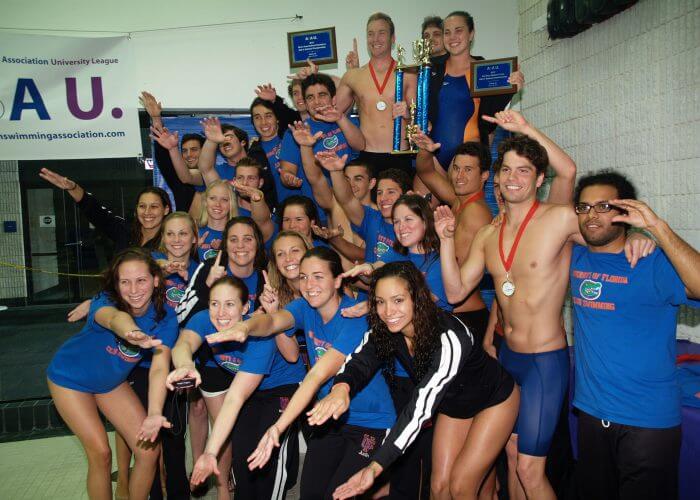
Photo Courtesy: Bridger Bell
This is higher than their share of overall CCS membership: an estimated 3.6% have varsity experience and 1.5% have Division I experience. However, the fact that this group of athletes’ proportion of entries at Nationals exceeds their membership proportion shouldn’t immediately be a cause for alarm, given their higher talent floor.
This isn’t a dramatic overperformance, nor is it pushing out the athletes without varsity experience: the proportional difference equates to an extra 47 athletes with varsity experience at Nationals this year. Meanwhile, the rest of the CCS membership is outperforming NQT projections by hundreds of athletes.
When it comes to earning a second swim in the finals session at Nationals, 63 former varsity athletes scored individual points, out of 408 total individual scorers at Nationals. Again, it isn’t a surprise that athletes with prior varsity team experience are outperforming the field, but to suggest that the entire Nationals finals session is saturated with them also overstates their presence. This still leaves 345 athletes who scored points for their club among 1519 non-varsity athletes at Nationals, or a scoring rate of 22.7%. This isn’t far off from the overall rate of 25%. For a national-level competition where some events can have over 200 entries, scoring swims are still reasonably attainable for the athletes without varsity experience.
Former varsity athletes are more likely to score or make finals, but they haven’t taken opportunities for second swims away to the extent that warrants their removal. The few exceptionally talented athletes were visible through their winning performances. But focusing solely on a few outlier individuals does not provide an accurate picture of the field’s overall competitiveness.
The Problem with Drawing the Line at Varsity Experience
Having varsity experience also isn’t a neat line that cleanly separates tiers of swimming performance. Some athletes with varsity experience did not score at all at Nationals, while others set numerous National records. Former varsity athletes who dominate are not unique to the most recent edition of Nationals, and dominance is not exclusive to varsity experience. Here are just a few examples:
Peter Paulus used his experiences with CCS and CU Swim & Dive (University of Colorado – Boulder) in 2022 to secure a roster spot with the University of Texas’ varsity squad in 2023. But before joining Texas, he was still a “true” club athlete without varsity experience, won the men’s 50-yard butterfly by nearly a full second, and set a CCS record that seemed untouchable at the time.
Only two years later, Thomas Askew from Club Swimming at UGA (University of Georgia) broke that record on his way to four individual titles and a clean sweep of the men’s butterfly records, also as a “true” club swimmer. He then earned a spot on Georgia’s varsity roster in 2025 and returned to CCS in 2026 after post-House roster reductions.
Delaney Carlton from Georgia Tech Club Swim completed her career on UNC-Chapel Hill’s varsity team and set CCS abuzz with the first sub-51.00 women’s 100-yard freestyle in 2025.
You could even go back to the early days of CCS, back when CCS Nationals was called the Collegiate Championship Meet. Alan Maher of Longhorn Swim Club (University of Texas-Austin) dropped a 1:42.97 in the 200-yard backstroke in 2012. This is the oldest recognized CCS National Meet record that no CCS athlete has come within 3 seconds of since. Maher competed at an elite level during his varsity swimming career with the University of Texas. After completing that chapter, he began graduate school, joined the Texas club team, and dominated.
Katherine Blake of Michigan Club Swimming won the 400- and 200-yard individual medley titles at 2026 Nationals by Ledecky-ian 10-second and 4-second margins and set a new CCS record in the 400-yard distance. She is considered a “true” club athlete and would likely make most Division I rosters if she had chosen that route.
These individuals were all very talented athletes and, judging by their performances, were racing at a different level from their peers. But they were all celebrated rather than treated as evidence that the league no longer belonged to “true” club swimmers. They found a home in CCS, even if some of them were swimmers whose competitive backgrounds do not fit neatly into the idea of the “typical” club athlete.
I also want to emphasize that a former varsity swimmer who joins a university club team, attends practices, travels with teammates, participates in club events, and contributes to the team’s social life is not just borrowing the CCS platform for competition. They are participating in and are full members of the same broader club experience as everyone else. Many present-day CCS clubs have one or two graduate students who joined after exhausting their eligibility at another varsity program, and they are valued members of their club’s social circles. Club swimmers with varsity experience are still club swimmers.
The question is not whether CCS should serve the “traditional” club swimmer or the fastest eligible swimmer who also happens to go to the same school as the club. These two concepts are not mutually exclusive, because CCS has never defined membership by a speed or talent ceiling. That line, even if it existed, wouldn’t be any better defined by an athlete’s prior varsity experience. If an athlete meets the eligibility criteria and contributes to the competitive and social experience that CCS exists to provide, then speed or varsity history alone should not make them any less of a member of the CCS community or less deserving of the full opportunities that membership provides.
Why Eligibility Restrictions Miss the Access Problem
Taken together, the data doesn’t support the idea that NQT drops or competitive imbalance are primarily due to “the population competing at the top of the meet shift(ing)”. The larger drivers of NQT difficulty are league-wide depth and membership growth, and elite performances have never been limited to athletes with varsity experience.
Therein lies the problem with pointing to athletes with prior NCAA experience as the reason for tighter qualifying standards or unreachable records. It places the blame on members who had no meaningful effect on the issues at hand and fails to address the broader causes.
A rule change based on the exceptional talent of a few would do little to solve the overall access problem and, more importantly, would exclude eligible athletes from the community that CCS was built to serve. Also lost in the debate is that not all former varsity athletes are setting records or winning multiple events. The complaints about a few individuals dominating or altering the competitive landscape don’t apply to them, but the suggested policies will still restrict their eligibility.
Therefore, the issue of an increasingly restrictive National Meet is a problem of league-wide depth, league expansion, and fixed capacities. The best way to significantly ease the pressure on NQTs and improve access to Nationals would be to work around capacity constraints and adjust the meet’s overall structure. This could include expanding to a four-day meet, reducing the number of individual events per athlete from 4 to 3, or even changing the prelims/finals format to timed finals. This, however, is a separate debate for a different day.
How CCS Can Prepare for the Future
I don’t believe that CCS leadership is ignoring the changing landscape of college athletics. Program cuts and roster limits at the varsity level are real challenges that will require creative solutions if they happen at scale. Nor do I believe they are ignoring the real concerns of swimmers who qualified for Nationals in prior years and find themselves on the outside looking in this year.
Meanwhile, it is fair for CCS members to care about team titles and record books. Those achievements matter to some athletes’ and clubs’ experience at Nationals, and former varsity athletes do have an impact on them. But top-end dominance, even when visible, is not by itself evidence of league-wide harm, nor should it justify broad eligibility restrictions that would apply to every former varsity athlete, including those who are not winning events, setting records, or altering team standings. Rather than tightening eligibility in response to a few exceptional performances, CCS should broaden the ways clubs and individuals are recognized through national awards that celebrate accomplishments both in and out of the pool.
It’s also important to remember that CCS doesn’t just serve the athletes who qualify for Nationals, or those who might have won a medal or made finals if a few faster athletes had not attended. CCS was also not founded as an “NCAA-lite” or “NCAA Division IV”. Competition is certainly an important aspect of CCS, but the organization has always been about the community built around swimming and keeping people in the sport: from athletes just getting their feet wet in the competitive space to those chasing personal bests, and everyone in between.
The varsity college athletics landscape has shifted dramatically over the last decade, and more changes are coming. Upcoming legislation being debated in Congress could stabilize Olympic sports under the NCAA structure or place them under even greater pressure. The future of varsity college swimming remains uncertain, and CCS should be extremely cautious about implementing policies that would harm current and future CCS members based on speculative projections, especially when the proposed solutions do not address the real root causes.
Addressing the root causes of the symptoms College Club Swimming faces today and could face in the future, such as faster qualifying times and a faster meet, requires a methodical, data-supported approach to arrive at an accurate diagnosis. Only then can an effective treatment be prescribed. To accomplish that, CCS should take steps to monitor NCAA competition history, both to continue enforcing its policies and identify trends as they appear.
The CCS Advisory Board has already shown that it can make targeted, data-supported changes to improve access or address competitive integrity concerns. Recent adjustments that have expanded Nationals’ capacity include adding a half-day in 2026 and allowing small clubs to add a swimmer to complete relays at Nationals. The Advisory Board also removed intrasquad meets from NQT eligibility this past season after falsified entries linked to intrasquads and time trial meets were identified following 2025 Nationals. As they have in these instances, CCS should continue to take the pulse of its membership and implement changes when symptoms and data warrant action.
What CCS should not do is reflexively exclude otherwise eligible swimmers before proving that they are the cause of the harm being attributed to them. Pushing former varsity athletes out of CCS in response to the exceptional performances of a few individuals feels like a rushed reaction at best and harmful at worst, because the data currently do not support the claim that their presence causes “clear, long-term, and significant harm to the rest of the membership.”
It is also this writer’s hope that public opinion shifts, and that we are kinder and more understanding toward our fellow athletes and teammates. It may be easy to point the finger at former varsity athletes and attribute the changes over the last few seasons to their presence, especially when they are setting records and showcasing their talent. But neither speed nor talent alone should make an otherwise eligible athlete a target of criticism, mistreatment, or exclusion.
Former varsity athletes, like every other member, joined CCS to continue being part of a team and to compete while representing their school. CCS is one of the most special and unique environments that makes that possible. And for every athlete who continued to put in the required training to maintain their varsity-level speed, there is another who rediscovered their love for competitive swimming through CCS. Removing their eligibility would take away those opportunities and be a net loss for the sport of swimming.
Former NCAA swimmers are, and have always been, a part of CCS’s story. But they are not the cause of, nor should they become the scapegoats for, the league’s latest growing pains.
Author’s Note and Disclaimers:
All data and figures referenced in this article were compiled from a combination of publicly available sources, including CCS registration rosters, Nationals entry lists, and SwimCloud and SwimPhone results, in addition to internal CCS documentation such as NQT committee notes and NQT projection analyses from 2023–26.
David Chen is a third-year medical student at the University of Wisconsin School of Medicine and Public Health. He is a CCS member competing with Swim Club UW-Madison, both as an undergraduate from 2017 to 2021 and as a professional student starting in 2024. He has served on the College Club Swimming Advisory Board since 2020 as a Regional Representative and Alumni Advisor. The views and opinions expressed in this article are his and do not represent the opinions of the College Club Swimming Advisory Board or its board members. This article is not endorsed by the College Club Swimming Advisory Board and does not serve as an official statement from College Club Swimming, US Masters Swimming, or any of its affiliates.