



















Co-Founder Kyle Sockwell Reflects on First Season of College Swimming League
A successful inaugural season has set the stage for an exciting future for the College Swimming League (CSL). Combining high-level collegiate competition with a fresh approach to the fan experience, the league has made its mark in its first year. The inaugural season concluded on November 6, with North Carolina State claiming the team title, but the momentum surrounding CSL is far from over. With a second season officially confirmed and new surprises expected, the league is already looking ahead to its next chapter.
In an exclusive interview with Swimming World Magazine, CSL co-founder and Chief Operating Officer Kyle Sockwell takes us behind the scenes of the league’s creation, sharing the inspiration behind the project, the challenges of turning an idea into reality, and his broader vision for bringing a new perspective to the sport of swimming.
Swimming World: Every great initiative starts with an idea. How did the concept of the College Swimming League (CSL) first come about? Was there a particular moment or realization that made you think this was something college swimming needed?
Kyle Sockwell: I have to give that credit to Rob Kent, my co-founder. He saw firsthand through the ISL how well team-format swimming works as entertainment, and he saw the NCAA market as a place where that format could really thrive. After the first season, I think it’s safe to say he was right. Now it’s time to refine the product and just keep making it better.
Swimming World: Turning an idea into an actual league is no small undertaking. What did the process of bringing CSL to life look like, from the initial conversations to making the inaugural season happen? What were some of the biggest challenges along the way?
Kyle Sockwell: The most difficult part was convincing college athletic departments to sign an agreement with an entity that had never existed, to take part in events with no true example to point to, and to do it all for a non-revenue sport. I think if there’s one thing our community underestimates, it’s the difficulty of that specific process. The 12 athletic departments and coaching staffs that signed on deserve a lot of credit for taking that leap with us.
Swimming World: You’ve consistently looked for ways to bring a more exciting and entertaining perspective to swimming. Why do you think it’s important for the sport to evolve beyond its traditional competition format, and what role did that vision play in creating CSL?
Kyle Sockwell: The sport is vulnerable. We rely on subsidization to survive, and there’s only so much room for sports in college athletics. Women’s and men’s volleyball are seeing massive growth because a fan can walk in and follow the game. I want ours to become one of those sports, and that means giving fans something they can follow, which our product does.
Swimming World: Now that CSL’s inaugural season has officially wrapped up, how do you reflect on its overall success? Did the league turn out the way you originally envisioned, or were there any unexpected moments or developments that stood out to you?
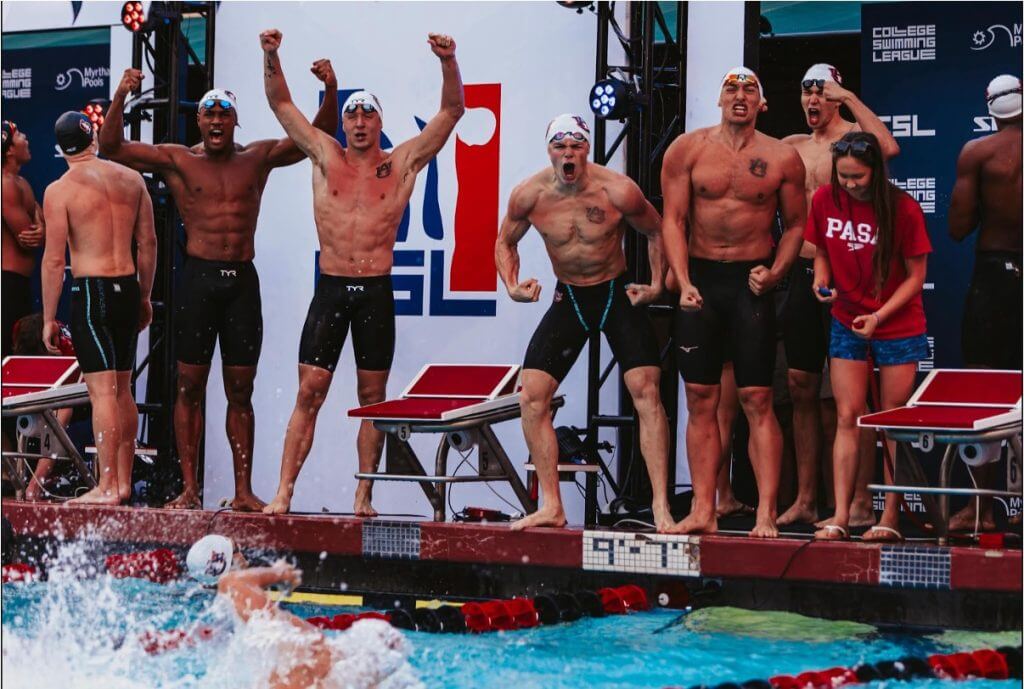
Kyle Sockwell: The goal for season one was always to just make it work. Create an in-venue product that’s compelling for fans, athletes, broadcasters, sponsors, etc. I think we did that. The moment that stood out to me most was the Auburn 200 freestyle relay at Match 3. Their men’s “A” relay won, and all six Auburn swimmers on deck were celebrating together, three of them from the B relay, while their own relay was still in the water. Normally it’s only the winning relay’s teammates celebrating. Team is greater than self in the CSL, and seeing that show up in season one was better than anything I envisioned. Now I’m excited to see what season two can look like when we apply what we learned.
Swimming World: Swimming has incredible athletes and performances, but attracting new audiences and generating broader investment in the sport can still be challenging. How do you see CSL contributing to changing that landscape and creating a stronger connection between the sport, its athletes, and its fans?
Kyle Sockwell: The CSL is as close to a “game” as college swimming has ever had. Initially, I thought calling it a “game” was cheesy, but then I had to kind of come back down to reality and remember that the sports we envy, from a product point of view, are all games. The CSL is something a non-swimming fan can walk into on a Friday evening, look up at the scoreboard, follow along with, and enjoy. The barrier to entry for a fan to enjoy the CSL is far lower than an invite, or a traditional dual meet where the score is an afterthought and the only thing that matters is how fast you went, not how the team is doing.
Swimming World: Looking back at the first season, what have been your biggest takeaways? Are there any lessons or feedback from athletes, teams, or fans that have already influenced how you’re approaching the next season?
Kyle Sockwell: Keeping this one short and sweet, the biggest takeaway is that this is something the community clearly loves. We had 7,369 tickets across eight events, a sellout at Georgia, and our Instagram went from zero to over 40,000 followers in a year. The product in-venue was like nothing I’ve ever seen or felt in our sport before, and a big focus for season two is bringing that feeling to viewers at home.
Swimming World: With Season 2 officially confirmed and new surprises on the horizon, what can you share about what’s coming next? Are there any new developments or initiatives you’re particularly excited for fans and athletes to experience?
Kyle Sockwell: We’re expanding to 16 teams, with a whole lot of refinement, but the same awesome experience that the CSL is already known for, only one season into its story.
Swimming World: Looking beyond Season 2, where do you ultimately see CSL heading? What would you love the league to accomplish in the next five years, and what kind of impact do you hope it will have on the future of college swimming?
Kyle Sockwell: When you see the impact the CSL is having on athletes and fans, it would be selfish to be conservative in our scale. We’re expanding so more teams can experience college swimming reimagined. In five years, I want college swimming to have a fall season that fans follow from the first match through the championship, and I want the sport’s place in athletic departments to be more secure because of it.