





Celebrating the 100th Anniversary of Gertrude Ederle and Her English Channel Crossing
Now that 2026 has arrived, we can embark on a year-long celebration of Gertrude Ederle, who became the first woman to cross the English Channel a century ago.
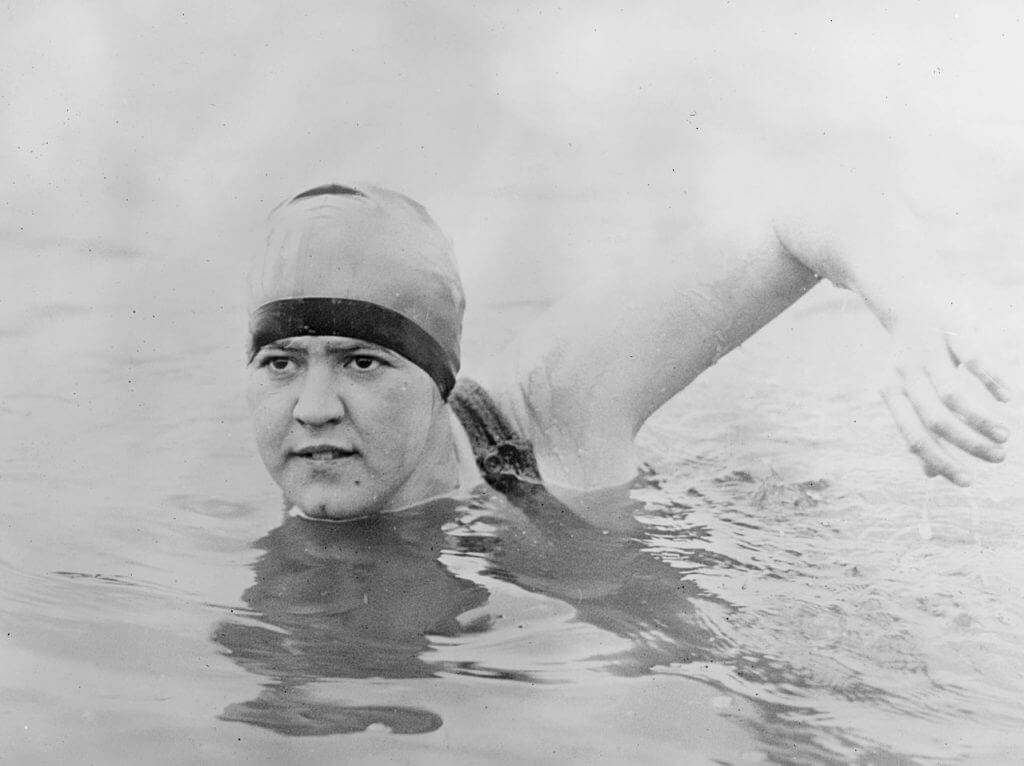
One hundred years ago, Gertrude Ederle became the first woman and sixth individual to swim the English Channel. Her 1926 time of 14 hours and 39 minutes crushed the previous speed record of 16 hours and 33 minutes. When Ederle returned to New York City, she enjoyed a ticker-tape parade, celebrated by an estimated two million supporters on August 27, 1926. She was a media darling with nicknames of “Queen of the Waves” and “America’s best girl.”
Ederle broke several barriers with her swim. Prior to her achievement, women were generally not accepted in sport and certainly not in endurance sports. She became a media star for many years. Ederle was deaf from childhood measles – and perhaps one of the first famous sporting heroes with a physical disability. On the technical side, she wore a revolutionary two-piece bathing suit and personally designed wrap-around goggles, which were kept watertight with molten candle wax. Finally, she was born in the USA to a German immigrant butcher and her fame, so soon after World War I, served as a healing moment for both the country and the world.
Ederle’s swimming journey, in the New York City area, benefited from several key initiatives in the sport. The Women’s Swimming Association was fairly new and sanctioned events allowed her succeed at an early age. Swimming had progressed from breaststroke to trudgen to the new freestyle. Her success started in 1917 at age 12, with the 880-yard freestyle. She became the youngest world-record holder in swimming, and in the ensuing years, she set eight more world records and held 29 U.S. national and world records from 100 meters to 500 meters.
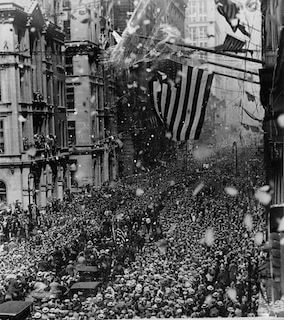
Photo Courtesy:
Females were allowed to swim in the Olympics starting in 1912 in Stockholm. Ederle qualified for the 1924 Paris Olympics and won three medals: gold and a world record as the leadoff swimmer on the 400-meter freestyle relay; bronze in the 100-meter and 400-meter freestyle races. Johnny Weismuiller was the only swimmers to top her three medals with four – including one in water polo. The United States Olympic team enjoyed its own ticker-tape parade in New York City, two years before Ederle had her own.
Ederle decided to turn professional in 1925 before her Channel swims, a common decision in the era of commercial sporting promotions. An early event was her 22-mile (35 km) swim from Battery Park (New York) to Sandy Hook in 7 hours and 11 minutes. This record time held for 81 years. That year, the Women’s Swimming Association sponsored two women, Ederle and Helen Wainwright, for English Channel attempts. Ederle joined a select group of swimmers and coaches at the Channel who were planning and training. Her coach was Jabez Wolffe (Great Britain) and her support crew was Ishak Helmy (Egypt) – both later inducted into the International Marathon Swimming Hall of Fame. Jabez made at least 22 unsuccessful English Channel attempts between 1906 and 1913 and was the leading expert on the “waters” while Ishak, after several unsuccessful attempts, finally crossed in 1928.
Ederle’s first crossing attempt was on August 18, 1925. In the interest of safety, Wolffe was worried about her condition and ordered Helmy to pull her out of the water during the swim. Perhaps the coach was right to end the swim or possibly her hearing was an issue. There was also an accusation that she had been poisoned. In any event, Ederle vehemently disagreed with the decision to pull her out of the Channel.
She returned the next year, in 1926, with different sponsors and coach/crew. This time, she completed the 21-mile (33 km) swim from France to England. Already famous, the media attention exploded.
Her fame led to a starring role in a movie, “Swim Girl, Swim.” She competed, among a field of 53 females, in the 10-mile (16.1 km) 1928 Canadian National Exhibition. It was the biggest race of the era in cold, eel-infested waters. Ederle placed sixth. In the longer 15-mile (24 km) men’s race, not a single swimmer completed the tough course. As a professional, Ederle exhibited her skills in theatres, vaudeville circuits, and aquacades. Her last known event was a cameo appearance at Billy Rose’s Aquacade at the New York World’s Fair in 1939.
Ederle, who never married, taught deaf children during her post-swimming career. Her influence on the sport was recognized through induction into the inaugural classes of the International Marathon Swimming Hall of Fame (1963) and International Swimming Hall of Fame (1965). They continue to immortalize her achievements. She passed away in 2004 at the age of 98 and there are several other reminders of her greatness:
- The annual Ederle Swim in New York.
- The Gertrude Ederle Recreation Center in New York City.
- A park and amphitheatre in Highlands, New Jersey, where the Aquacade was held.
- A New York City sidewalk marker on Broadway just north of Beaver Street, on the left when traveling south.
- Kingsdown, England plaque in the pub, “Rising Sun.”
- Two annual English Channel Awards: The Channel Swimming Association World Record Two-Way Swim; and the Channel Swimming & Piloting Federation – For the most meritorious swim of the year by a woman.
Gertrude Ederle also was the first female to set an overall speed record in a major marathon. This paved the way for more women to accomplish a similar feat:
- Florence Chadwick and Tina Bischoff – English Channel.
- Arianna Bridi – Capri to Naples.
- Tamara Bruce – Rottnest Channel.
- Karen Burton Reeder – Catalina Channel.
- Grace “Gracie” van der Byl and Suzanne Heim-Bowen – several speed records.
- Marcia Cleveland – Triple Crown.
- Penny Lee Dean, EdD – English and Catalina Channels.
- Ida Elionsky – Manhattan Island.
- Brenda Fisher, BEM – Morecambe Bay
- Irene van der Laan – Two-Way English Channel
- Michelle Macy – Oceans Seven
- Judith de Nijs – Lac St. Jean
- Shelley Taylor-Smith – Manhattan Island and Sydney to Wollongong
The sport of marathon swimming has exploded in the past 20 years. Thousands of women who have completed marathon swims will take special notice of 2026, the centennial anniversary of Gertrude Ederle’s record setting English Channel swim.