



















Australian Swimming Greats Remember The Magic Of The 1956 Melbourne Olympic Games Some 70 Years On
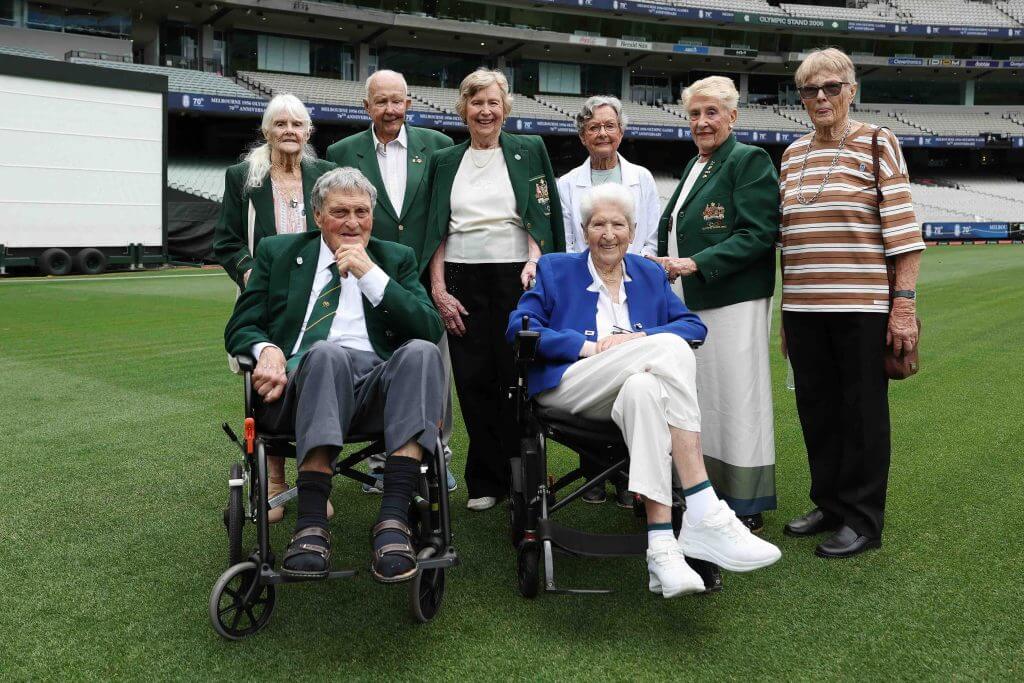
Nine members of the 1956 Australian Olympic swim team, including gold medallists Dawn Fraser, David Theile and Sandra Morgan took a trip down memory lane in Melbourne yesterday for the 70th Anniversary of the Melbourne Games.
The celebrations marked the day of the Opening Ceremony of the Games of the 16th Olympiad at the Melbourne Cricket Ground (MCG) – a Games that featured an Australian team of 309 athletes.
A reunion that saw 32 of the known 54 surviving members of the team that were part of a landmark moment in Australia’s sporting history and on the exact day the iconic MCG opened the Games.
It was a day respected Olympic historian; the late Harry Gordon had reflected on in his book “Australia At The Olympic Games”- a man who had a special love affair with the Games and everything it brought to the Australian shores for the first time.
Gordon writing: “When the Olympic Games moved into Melbourne from, November 22 to December 8 in 1956, it was as if the city had been brushed with a certain magic.
“Nothing before or since – no football final or Test cricket match or Melbourne Cup (horse racing), neither the departure of (explorers) Burke and Wills nor the arrival of The Beatles had ever evoked such sheer emotional involvement from the whole community.
“And apart from the overall medal successes and the arrival of legendary stars that included swimmers Fraser, Murray Rose, Lorraine Crapp, Jon Henricks and Theile there was a dimension that seemed almost transcendental about those Games and at a time of fierce international tension, but a Games that provided a reassuring innocence.”
Memories that came flooding back to team members who were honoured at a special luncheon, recognised for helping shape Australia’s Olympic story and celebrating their enduring place in Australian sporting history.
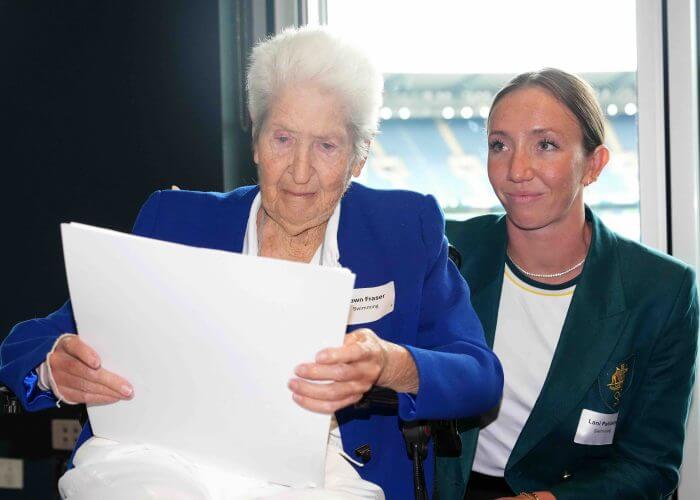
JUST FOR THE RECORD: Dawn Fraser is presented with a World Record certificate for a Women’s 100m Freestyle swim in 1956 during the Australian Olympians Association Lunch.With god daughter and 2024 Olympic gold medallist (4×200) Lani Pallister. (Photo by Asanka Ratnayake/Getty Images for AOC).
And for a swim team arguably regarded as Australia’s greatest ever– winning eight of the 13 events – including all five freestyle gold medals, sweeping both the men’s and women’s 100m freestyles, winning the two relays and the men’s 100m backstroke.
A Games that saw the arrival of 19-year-old Fraser, who would become the sport’s golden girl of the pool and triple gold medallist Murray Rose – a man known in Australia as “The Seaweed Streak” and who would also leave his mark in Hollywood.
Fraser won the first of her three history-making 100m freestyle Olympic gold medals (adding Rome and Tokyo) – leading the Australian girls to a rare podium sweep with Lorraine Crapp and Faith Leech, taking silver and bronze respectively.
Before the trio combined with Morgan, the 14-year-old baby of the team, to win gold in a world record time in the 4×100, freestyle relay.
While Rose won the 400 and 1500m freestyle double – joining 100m freestyle golden boy Jon Henricks, John Devitt and Kevin O’Halloran to win the 4x200m freestyle relay.
Australian Swim Team Medallists Honour Roll, 1956 Melbourne Olympics
Murray Rose (NSW) Gold 400m, 1500m freestyle, Gold 4x200m freestyle relay
Dawn Fraser (NSW) Gold 100m freestyle, Gold 4x100m freestyle relay; silver 400m freestyle
Jon Henricks (NSW) Gold 100m freestyle, Gold 4x200m freestyle relay
Lorraine Crapp (NSW) Gold 400m freestyle, Gold 4x100m freestyle relay; Silver 100m freestyle
David Theile (QLD) Gold 100m backstroke
John Devitt (NSW) Silver 100m freestyle, Gold 4x200m freestyle relay
Gary Chapman (NSW) Bronze 100m freestyle; Gold 4x200m freestyle relay
Faith Leech (NSW): Bronze 100m freestyle; Gold 4x100m freestyle relay;
Sandra Morgan (NSW): Gold 4x100m freestyle relay;
John Monckton (NSW):Silver 100m backstroke
Fraser, who flew to Melbourne from her home on the Queensland Sunshine Coast and is now confined to a wheelchair, spoke about how proud she was to compete in front of a home crowd and the connection she has with younger athletes looking towards Brisbane 2032.
“Walking out on MCG again today and it felt like you could hear the crowd. It was absolutely fantastic, it really was. I think a lot of the Olympians felt it too,” said Fraser.
“Melbourne 1956 was a proud moment of everyone’s life in the Team, to walk out here for the Opening Ceremony and be the last Team to walk out and we were really applauded which made us feel so very proud.
“I swam for my country, not for myself and it was always a pleasure to be an Australian.
“We’ve got a fantastic generation of young kids wanting to compete in the Brisbane Games and to me, that’s giving them something to think about…we didn’t have that.
“I’ve been talking to a lot of 13- and 14-year-old swimmers and they’ve asked me what’s (a home Games) like and I say ‘you have to experience it yourself’ because it’s a wonderful experience.”
While swimming surgeon Theile and his unique flip turn, was the man who turned backstroke racing on its head, up-setting his Aussie teammates (John Monckton who won silver and John Hayres (fifth) and his US arch-rivals to win the first of his back-to-back gold medals, defending his crown in Rome in 1960.
Theile, giving insights into a team that took the Olympics by storm.
Theile, now 88 remembered and his race in Melbourne like it was yesterday, saying “Prior to our event (the 100m backstroke) our freestylers had swept the pool; every freestyle event was won by Australia and that gave us a huge amount of confidence….those were the reasons I went out with the confidence.
“My race was pretty straight forward…my general philosophy in life is always to have a purpose, drive towards it….and get there.
“And that has served me with everything I’ve done subsequently, but I believed that I mastered every part of the race, the start, the turn…there has been a lot said about my turn but that’s not absolutely got me to a one second win.
“I did it all right….and I was up against John Monckton who was subsequently the world record holder…and we went to the next Olympics and he was the world record holder and I managed to win on the second occasion as well.
“For Australia to win eight gold medals of the 13, I was incredibly privileged to be part of the most successful swimming team Australia has every had.
“We have seen some great accomplishments by Australian swimmers since ..but to win eight of the 13 absolutely surpassed the Americans.
“But I came very much out of left field…from several points of view…firstly I came from (Maryborough) in country Queensland….and I was the only Queenslander that swam at the ‘56 Olympics…and imagine that now by comparison, because Queensland dominates.
“It was a great decision by the Australian Swimming Union in 1956 to send the team to (the sunshine of) Townsville to train for three months…it was the master stroke.
“A move that took us to the supremacy that we had in the pool in Melbourne…and I was also able to do my studies (to become a doctor) and do my medical exams from up there. So I was able to put it all together….”
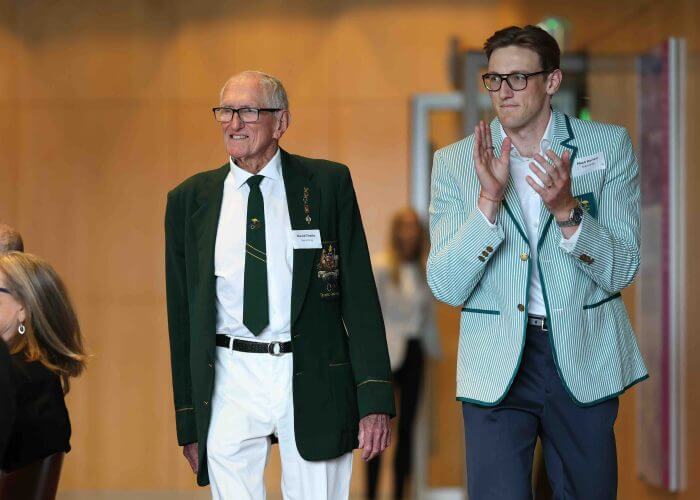
GOLDEN BOYS David Theile (1956,1960) and Mack Horton (2016) arrive during the Australian Olympians Association Lunch on (Photo by Morgan Hancock/Getty Images for AOC)
President of the Australian Olympic Committee (AOC), Ian Chesterman AM, paid tribute to the Team and their legacy as well as recognising a Games when Australia welcomed the world with enormous pride, optimism and ambition.
“Seventy years ago, Melbourne opened its arms to the world and you stood at the centre of it. Many said it could not be done this far from the rest of the sporting world and you proved them wrong,” said Chesterman.
“Your legacy runs deeper than the medal count. The sportsmanship and spirit the 1956 Team showed on home soil still defines what it means to be an Australian Olympian.
“Every Australian athlete who has pulled on the green and gold since 1956 owes something to you. You set the standard and laid the foundations on which every Australian Olympic Team since has been built.
“You inspired a generation of children to join their local pool, track, club or court. You showed a young country what was possible when it dreamed big and backed itself.
“As we look ahead to Brisbane 2032, today is a reminder of the legacy a Home Games can leave for generations to come.”
Holding a unique place in Australian sporting history, Melbourne 1956 was the first Olympic Games held in Australia, the first staged in the Southern Hemisphere and the first to capture the public’s imagination with live television broadcasts.
SWIM NOTE: The Australian Swimming Union named a squad after the National Championships in February of 1956 and in a revolutionary moved added a program of calisthenics at two gymnasiums at Sydney’s Tattersall’s club and Frank Findlay’s Melbourne Fitness Centre – following the success of the US team with its Bob Kiphuth inspired calisthenics exercises that had boosted the Americans at the 1948 London Games and 1952 in Helsinki.
The Squad then moved into an eight-week Far North Queensland training camp under the sunny skies of Townsville which was a real gamechanger – the first time the Australians had training through the winter.
During a single carnival the swimmers broke six world records and 13 Australian records with Lorraine Crapp breaking four world and two Australian records becoming the first woman to break five minutes for 400m freestyle.
The swimmers were billeted with private families; while the coaches were paid £20 a week – the entire scheme costing £8000 – and funded by series of carnivals in Townsville, Brisbane, Sydney and Melbourne.