




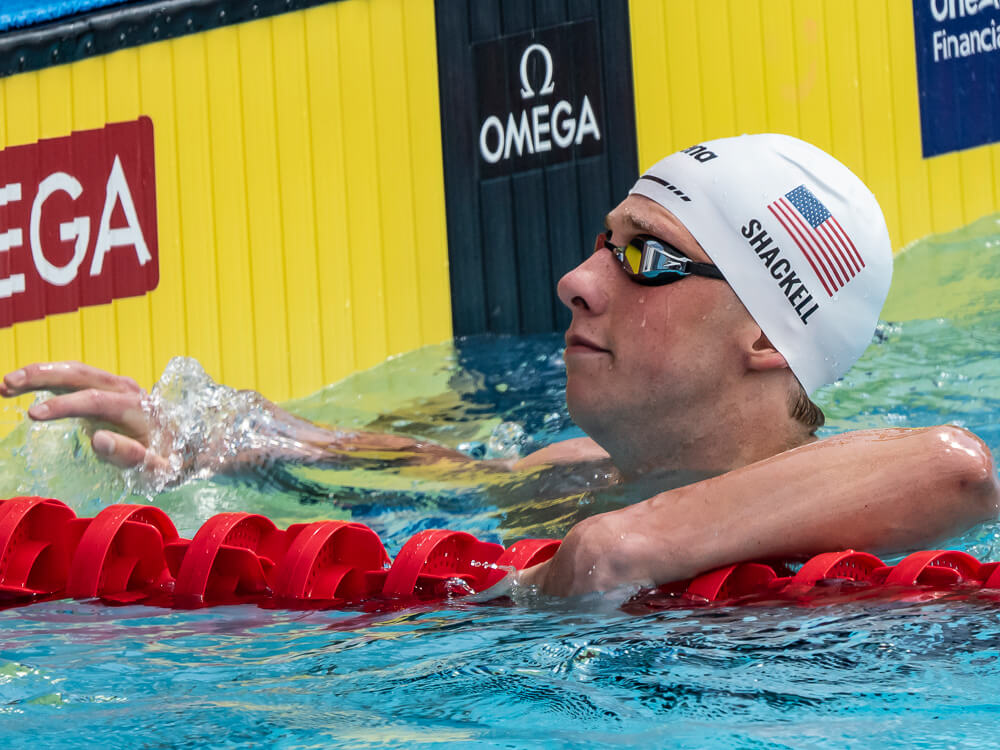















Aaron Shackell, Luka Mijatovic, Ryan Erisman Leading American Resurgence in 400 Freestyle
The 400 freestyle has been a constant struggle for the U.S. men over the last decade, with few breakthroughs at major international meets. Kieran Smith pulled off a surprise bronze medal in the event at the Tokyo Olympics, but on the World Championships level, no American has reached the podium since Connor Jaeger captured bronze in 2013. For some perspective, Jaeger has been retired more than a decade. Before that swim, no American man had medaled in the event at Worlds since 1986.
Perhaps that momentum will change in the coming years thanks to the arrival of a new generation of 400 freestylers. Aaron Shackell, Luka Mijatovic and Ryan Erisman all flashed with impressive swims this summer, and all currently rank among the top-eight swimmers in the world this year. Moreover, all three are relatively young by swimming standards: Shackell, already an Olympian, is 21 years old, while Erisman is 20 and Mijatovic just 17.
Shackell supplied a massive personal-best swim on his way to an unexpected podium finish at the Pan Pacific Championships. Racing alongside Australian Sam Short, who dominated freestyle events from 400 through 1500 meters this summer, Shackell swam in second place for much of the final. China’s Zhang Zhanshuo had too much speed for Shackell to handle down the stretch, but he still finished in 3:43.44 for a bronze medal and a personal-best time by more than 1.5 seconds.
Shackell has more experience than anyone else in this group, having scored an upset win in the 400 free two years earlier at the U.S. Olympic Trials. He went on to qualify for the Olympic final in Paris, only to fall well behind and finish eighth. Now, though, Shackell has established himself as a contender in advance of his hopeful return to the global level.
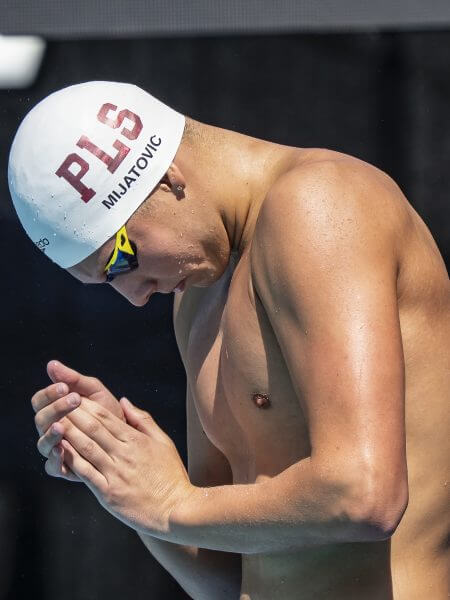
Luka Mijatovic — Photo Courtesy: Peter H. Bick
Mijatovic, meanwhile, has been in the position of up-and-comer for several years now. He earned an unexpected spot on the 2025 World Championships team after dropping more than three seconds from his best time at the 2025 selection meet. Mijatovic would struggle badly in his senior-level international debut, fading to a 36th-place finish with a time more than 14 seconds off his best after he struggled with the effects of a gastrointestinal illness that affected most American swimmers.
That turned out to be a temporary setback as Mijatovic made another leap in 2026. Having topped out at 3:45.71 last year, Mijatovic lowered his personal best to 3:43.45 in a win at U.S. Nationals last month. Mijatovic and Erisman swam stroke-for-stroke for much of that race before Mijatovic turned on the jets down the stretch. Weeks later, Mijatovic swam just a tick slower at Junior Pan Pacs, his time of 3:43.67 good enough for one of his individual golds.
Erisman just missed joining Mijatovic and Shackell in the 3:43-range, although his top swim actually came earlier in the calendar when he clocked 3:44.03 for a two-second best time at the AP London International in late May. Erisman went on to win three national titles in July, topping solid fields in the 200 free, 400 IM and 800 free, but Mijatovic was just a bit better in the 400.
When the dust settled on this summer’s regional competitions, the trio of Americans ended up not far off the pace. Unsurprisingly, Short leads the world rankings with Zhang second and world-record holder Lukas Martens third. Leon Marchand, who made his first international appearance in the 400 free this year, won the European title in the event to move into a tie for fourth with Oliver Klemet. Behind them sit the three Americans, with five others having been 3:44 this year.
All-time among Americans, Shackell ranks fifth, Mijatovic sixth and Erisman ninth, and these performances have finally put the American record under duress. The mark still stands at 3:42.78, set by Larsen Jensen in the Olympic final back in 2008. Rex Maurer, also 21, owns an even quicker best time with the 3:43.33 he swam last year, and Maurer will hope to return to top form over the next year after a tough 2026.
Moving forward, Shackell, Mijatovic and Erisman must continue to make incremental improvements to position themselves for a medal run as soon as next year’s World Championships, but all finish the championship season with serious momentum on their side.