



















Fatherhood Inspired Brad Snyder To Be His Best — And To Return To The Pool
By Karen Price
For Paralympic champion swimmer and triathlete Brad Snyder, trying to pick a favorite part of fatherhood is like trying to pick a favorite leg of a race.
The whole point of triathlon, he said, is to spread everything you’ve got across the entire course. That pursuit of excellence and of becoming the best version of yourself is ultimately what makes it rewarding. Win, and you can recognize that you operated to the best of your ability that day. Lose, and you learn from it and resolve to do a little better next time.
“That’s what I love about parenting too,” said Snyder, who recently announced a return to competition after a four-year break following the birth of his daughter, with a goal of competing in Los Angeles in 2028. “Every day is simultaneously exhausting and incredibly rewarding. Fully investing yourself in the development of a young human being is such a profound challenge, but watching your child learn new things, develop new skills, try new foods, tell jokes and experience the full emotional breadth of what it means to be human is just amazing.”
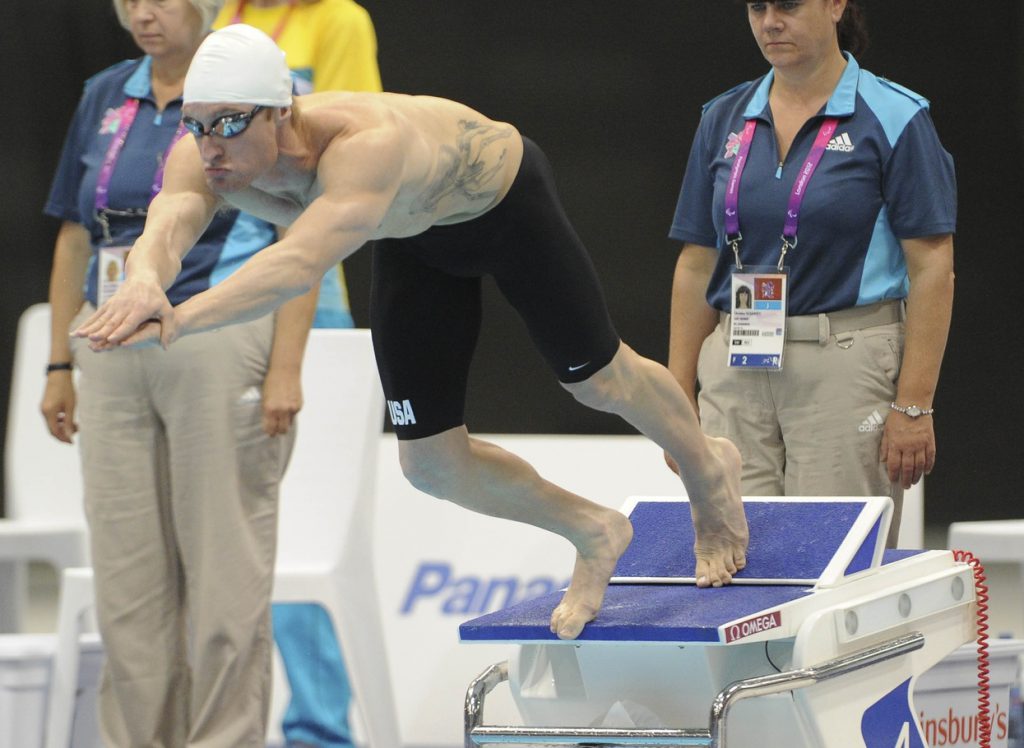
Snyder grew up a standout swimmer and served as captain of his team at the U.S. Naval Academy. While serving in Kandahar, Afghanistan, in 2011 he stepped on an improvised explosive device and lost his vision. One year later, Snyder swam for Team USA at the Paralympics in London and won gold in the men’s 100- and 400-meter freestyle S11, and silver in the 50-meter freestyle. He went to his second Paralympic Games four years later in Rio, winning gold in the 50-, 100- and 400-meter freestyle S11 and silver in the 100-meter backstroke. Then he shifted his focus to paratriathlon and won gold in the event in Tokyo 2020.
Daughter Rooney Mae was born in 2022, and although Snyder said in a social media post that it was never his intention to officially retire from the sport, he wasn’t ready to compete again by the time the Paris Paralympics came around in 2024. But with Los Angeles two years away, he’s ready to come back to the pool. And his daughter, he said, is “probably the biggest reason.”
“Of course, every athlete dreams of competing in front of a home crowd, so that’s certainly part of it,” Snyder said. “But for me, the idea that I could, in some sense, ‘pass the torch’ to my daughter on a stage as meaningful as LA28 feels incredibly special.
“Before my daughter was born, so much of my athletic journey centered on me. What did I want to accomplish? Could I win? Did I have what it took? Then, after success came, I spent years traveling around and speaking publicly about my own story and experiences. The moment I became a father, it became very clear to me that I was no longer the center of my universe. That changed the way I look at everything.”
Snyder admits that training now is a bit different than preparing for previous trips to the Games. Not only does he have a daughter, but his commitments outside the pool include serving as member-at-large on the International Paralympic Committee’s governing board, a position to which he was elected last year.
He has to remember to give himself grace; it’s a piece of advice he recommends to other athlete dads as well.
“I have to manage my time and energy differently,” he said. “I’m never going to be exactly who I was before, so instead of chasing some past version of myself, I’ve tried to give myself permission to fully embrace who I am today. That’s still a challenge. But there’s also freedom in it. There’s freedom in accepting where you are in life and committing yourself to becoming just a little bit better every day.”
Being the father of a young child has taught Snyder how to keep a lot more balls in the air than he used to, he said. It’s also taught him patience, including how to slow down and move at the pace that works for her in order to give her the space she needs to learn and develop. Snyder said parenting also develops resilience simply from finding himself in situations he doesn’t always know quite how to handle.
It also has him thinking about the meaning of legacy in a much different way than before. It’s no longer just about winning races or collecting medals, he said. It’s about how he conducts himself in victory and defeat, how he trains, how he competes, and what his sportsmanship communicates about his values.
Of course, he’d love it if sports become part of his daughter’s life, whether in swimming or triathlon or something else. But they’ll see where her passions lead her.
“For me, LA28 feels like an opportunity to put a meaningful bow on an incredible athletic chapter of my life,” he said. “In some ways, it feels like a final wave to the crowd before stepping fully into a new role. I’ve already started moving backstage over the last few years, and after this chapter, my greatest passion will simply be supporting my daughter and empowering her journey however I can.”
The above article was sent to Swimming World via a press release by USA Para Swimming. Karen Price is a reporter from Pittsburgh who has covered Olympic and Paralympic sports for various publications. She is a freelance contributor to USParaSwimming.org on behalf of Red Line Editorial, Inc.